Why deep customer understanding is the growth edge CPG teams cannot afford to outsource to data and algorithms
Executive Summary
The most dangerous moment in any CPG strategy meeting is not when someone challenges the data.
What matters is deep customer understanding when no one raises questions.
AI and analytics give CPG teams more information than any prior generation of managers.Moreover, managers have had access to more data than ever before.
Consequently, that should mean deep customer understanding, sharper decisions, closer connection to consumers, and stronger commercial outcomes.
Organizations are becoming data-rich and reality-poor. Measuring everything and understanding progressively less about why consumers actually behave the way they do.
The evidence is uncomfortable. Moreover, Forrester’s 2025 CX Index found that US customer experience quality fell for the fourth consecutive year. This decline reached a new average low of 68.3, reflecting deep customer understanding gaps. Additionally, Forrester links the decline to weaker employee experience, waning customer obsession, and disappointing technology implementations. It notes financial volatility as another factor.
Zendesk’s 2026 CX Trends reports that 83% of consumers believe their experiences should be better.
However, in spite of significant AI investment in customer service and experience operations, expectations for 24/7 availability have risen.
Additionally, customer experience still is not improving fast enough.
At the same time, the market research services sector continues to grow. Research and Markets estimates it will reach $96.77 billion in 2026, while Greenbook’s 2026 GRIT material confirms that as analytics teams expand methods for scale, researchers continue to prioritize depth, context and understanding.
This post is for managers in marketing, sales, insights, innovation, category, and customer experience.
However, they are managing the tension between the speed of AI and deep customer understanding.
The argument is not that AI is unhelpful. It is that AI accelerates the wrong answer as efficiently as the right one. Deep customer understanding is the only reliable protection against confident mistakes.
Prefer to listen rather than read?

AI Makes Weak Understanding Look Confident
I have spent too many years in CPG meetings where everyone had a chart, but nobody could clearly explain the consumer.
There was always a number. Sometimes too many numbers. Brand tracking, penetration, loyalty, basket mix, claimed purchase intent, price elasticity, click-through, satisfaction, complaints, social listening, category growth, distribution, and more dashboards than any human being could reasonably absorb.
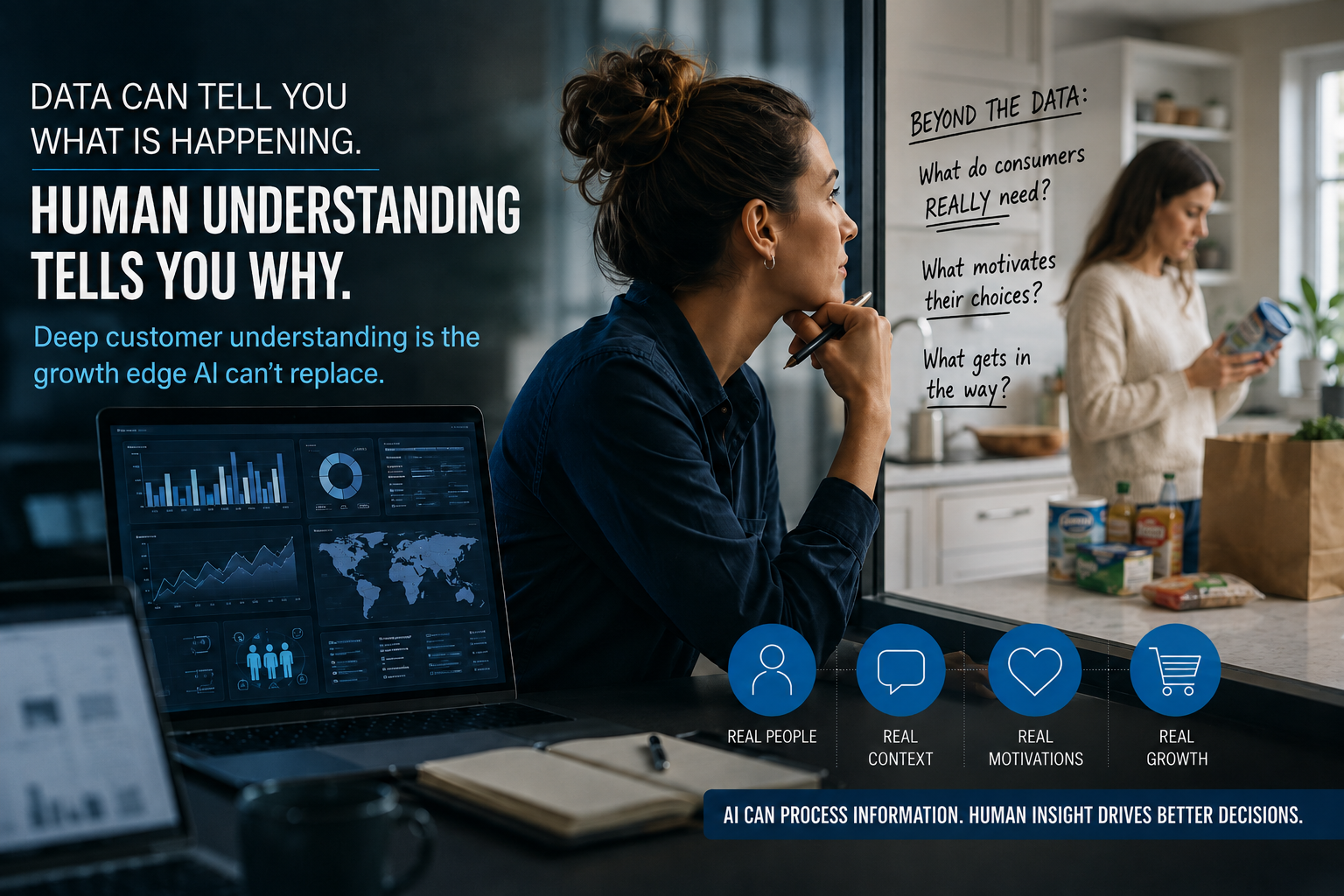
Yet the most useful question often remained unanswered: why is the consumer really behaving this way?
Not what they clicked; not what they bought; not what the model predicts they might do next; but why?
AI has sharpened that tension rather than resolved it. A model can summarize faster than any team. It can identify patterns nobody would have found manually. It can classify complaints, cluster reviews, generate personas, draft hypotheses and produce neat strategic language in seconds.
That is genuinely useful. But it’s also dangerous when the organisation stops challenging the output.
A clean AI summary can make thin data sound complete. It can turn contradictory consumer responses into a tidy theme. It can remove the awkward pause in the focus group, the nervous laugh in the interview, or the contradiction between what someone says and what they actually do.
MIT researchers Sinan Aral, Haiwen Li, and Rui Zuo published a paper in February 2026. They studied 24,000 search queries across 243 countries. They found AI search surfaces significantly fewer long-tail information sources. They found lower response variety and more low-credibility information compared to traditional search. However, users exposed to AI summaries formed more confident but less accurate beliefs on contested topics. This underscores deep customer understanding in evaluating AI-generated information.
That research is not specifically about CPG, but the implication transfers directly.
Moreover, when AI compresses the world into a convenient answer, people may stop searching around the problem. They may stop asking what is missing. They may accept the first plausible answer because it arrives with the same authority as a carefully researched one.
Real consumers do not behave like AI summaries. Additionally, they forget. Also, they rationalize. Yet they contradict themselves. They say price matters, then buy the brand that makes them feel safe. Moreover, they claim to want sustainable packaging, then reject it when it looks less premium. However, they say they love choice, then freeze when the shelf becomes too complicated. Thus, deep customer understanding.
That friction isn’t noise to be cleaned up. It’s often the insight.
More Data, Worse Decisions: What the CX Numbers Are Really Saying
Customer experience is where weak consumer understanding eventually becomes visible.
A brand can hide poor internal alignment inside meetings and systems for a while. Consumers eventually feel the consequences.
They feel it when a pack changes and the value no longer makes sense. They feel it when a reformulation technically performs, but no longer feels like the product they trusted. They feel it when a product disappears from shelf and nobody explains whether it is temporary, discontinued, reformulated, or simply out of stock. They feel it when an AI chatbot answers the wrong question with complete confidence, or when customer service is efficient but unhelpful.
They also feel it when a brand claims to be customer-centric but behaves as though the customer is an interruption.
Forrester’s 2025 CX Index is unambiguous. US CX quality fell for the fourth consecutive year, reaching an average low of 68.3.
Forrester links the decline directly to weaker employee experience, waning customer obsession, disappointing technology, and economic volatility.
This reveals deep customer understanding.
That phrase from Forrester’s own report — waning customer obsession — deserves to sit in every CPG brand review. It is a precise and uncomfortable description of what happens when an organization convinces itself it is customer-centric because it has more data, while at the same time investing less in the human work of understanding what that data means.
Zendesk’s 2026 CX Trends reinforces the picture. 83% of consumers believe their experiences should be better than they currently are, despite the significant AI investment in customer service and experience operations in recent years. [https://cxtrends.zendesk.com/]
Together, these two data sources describe the same failure pattern from different angles. Organizations are investing in efficiency. Consumers are experiencing distance.
That gap is where trust erodes, loyalty softens and competitors start to look more appealing.
Deep customer understanding changes the quality of CX decisions because it shows where consumers feel anxious rather than merely dissatisfied. It exposes the moments they tolerate until a competitor gives them a better option. It helps teams see where operational efficiency has become coldness, where automation has become avoidance, and where the organization’s idea of convenience does not match the consumer’s reality.
Additional measurement will not fix that on its own; deep customer understanding is also needed, because someone still has to understand what the customer is living.
Deep Customer Understanding Is Not Going Backwards. It Is Becoming More Urgent.
There is a temptation to frame the current moment as qualm is back.
That is not quite right, and it is worth being precise.
The old version of qualitative research — a few focus groups behind glass, a long report full of quotes, and a debrief that took three months to produce — is not sufficient for today’s speed. Some traditional qualitative work was slow, expensive and over-interpreted. Focus groups often rewarded the loudest voice in the room. Some debriefs became more theater than decision support.
The answer isn’t nostalgia. It’s deeper human understanding, gathered faster and applied closer to the business decision.
Greenbook’s 2026 GRIT material captures the shift clearly. As analytics teams expand methods for scale, they seek deep customer understanding. Moreover, researchers continue to prioritize depth, context and understanding.
That is the tension facing CPG teams: scale without depth produces patterns without meaning [https://www.greenbook.org/grit/insights-practice-edition].
The Business Research Company estimates the MRX industry reached $93.37 billion in 2025 and expects it to reach $116.02 billion by 2030, with AI-driven real-time research platforms identified as a key growth driver alongside traditional qualitative and quantitative methods. Research and Markets projects the market will reach $96.77 billion in 2026.
That growth does not prove every company is spending more on depth interviews. It does confirm that insight work remains commercially essential and is evolving rather than disappearing under AI pressure.
The most valuable development is not more focus groups. It is better human understanding. AI-assisted qualitative platforms, online communities, video diaries, social listening, customer calls, review analysis, ethnographic snippets and continuous discovery can all help, but only if they bring the organization closer to consumer reality rather than further into abstraction.
The method matters less than the outcome.
Does it help the team understand what customers mean, fear, expect, avoid, forgive, compare and quietly resent? If it does, it has value. If it only creates a prettier summary, it does not.
How Organizations Drift Away From Reality Without Noticing
Distance from consumer reality rarely announces itself. It begins with language.
Consumers become segments. Complaints become tickets. People who cannot afford the new price become price sensitive. Confused shoppers become low engagement. Lost buyers become churn. A frustrating experience becomes friction.
Those terms are useful for analysis, but they become dangerous when they replace the human being.
Then decisions start to drift, often gradually. A concept score is strong, so the team launches an innovation, but nobody has understood the usage context well enough. A pack is optimized for cost efficiency but becomes harder to open, store or read. A brand refresh looks cleaner in the deck but loses the recognition cues shoppers relied on. A service chatbot reduces operating cost but increases customer effort. A retailer presentation claims consumer excitement when the real shopper response is cautious interest at best.
The company may see optimization, but the consumer experiences erosion.
This matters particularly in CPG because so many decisions are small, fast and cumulative. A claim changes. A pack shrinks. A formulation adjusts. A retailer listing shifts. A promotion disappears. A sustainability message becomes more visible. A customer service script becomes more automated.
None of these may look dramatic in isolation. Together, they can profoundly change how a consumer feels about a brand over time.
Deep customer understanding catches those gaps earlier. It gives someone in the room the evidence and language to say: that may be what the data shows, but it is not how people are living this.
That sentence can save a business from expensive mistakes.
A 2025 study bench-marking AI in customer experience management found that even state-of-the-art embedding and generation models reached only 68% accuracy on article search in realistic CXM scenarios, while standard embedding methods produced a low F1 score for knowledge base refinement.
Real operational customer experience is difficult, messy and context-heavy in ways current AI still handles imperfectly. That should make CPG teams cautious about letting automated outputs overrule the human work of interpretation.
What Deep Customer Understanding Actually Looks Like in Practice
Deep customer understanding is not one big annual study. It’s a discipline, to stay close enough to the consumer that strategy does not become self-referential.
For CPG teams, that means combining several types of evidence deliberately. Sales data shows behavior. Reviews show language. Customer service data shows pain. Social listening shows public frustration. Search data shows interest and anxiety. Retailer feedback reflects commercial pressure. Ethnography and interviews reveal context. Qualitative communities track change over time.
AI can help process and organize these signals efficiently. Humans still have to decide what is true, what is noise and what matters commercially.
A manager working on pet food should not only know that a product has lost share. They should understand whether owners are concerned about digestion, value, availability, ingredient safety, pack size, or whether their pet will simply reject a substitute.
A manager working on household care should not only know that a claim is under-performing. They should understand whether shoppers distrust the wording, misread the benefit, worry about ingredient safety, or cannot see the difference quickly enough at shelf.
A manager working on a food brand should not only know that repeat purchase has softened. They should understand whether consumers feel the pack is poorer value, the taste has changed, the claim is less believable, the product is harder to find, or the brand simply feels less relevant to the way they are eating now.
That is not soft thinking. That is commercial thinking.
Deep customer understanding reduces the risk of solving the wrong problem beautifully — which is an expensive habit in a margin-pressured environment.
The most valuable managers in the next phase of CPG growth will not be the ones who use AI most. They will be the ones who know where AI helps and where it must be checked against human reality. That distinction is a career advantage as much as a business one.
How CATSIGHT™ Brings the Consumer Back Into the Room
CATSIGHT™ is valuable here because it stops teams rushing from data to decision without passing through an important reality check.
Before the dashboard, the prompt, or the tactical fix, it asks four questions that organizations under time pressure tend to skip.
- What’s the consumer actually experiencing in this category right now — not what the business assumes, but what the consumer is living?
- What are they truly trying to achieve? A parent buying baby food is not simply buying nutrition; they’re also buying reassurance. A shopper switching household cleaners isn’t just seeking efficacy; they may be juggling safety, habit, trust and anxiety simultaneously.
- Which specific consumers matter most to this commercial outcome, and what tension is driving their behavior? Demographics are a starting point. The tension is the insight. Fourth: what human truth should guide the business response? AI can surface candidate themes from data at speed. It cannot yet determine which candidate reflects what consumers actually feel. That judgment still requires human contact with consumer reality.
The sequence matters because it connects understanding to action. An insight that only marketing understands is a research finding. An insight the whole organization acts on is a competitive advantage.
CATSIGHT™ prevents insight from becoming decoration. It brings the human truth back into the room at the point where organizations are most tempted to replace it with a convenient summary.
Where QC2™ Adds Organizational Discipline
Customer understanding often fails not because the insight was poor, but because the organization was not aligned around what it wanted the customer to experience.
One function sees cost. Another sees brand equity. Another sees service levels. Another sees data quality. Another sees risk. Everyone may be correct within their own frame and still collectively wrong for the consumer.
QC2™ helps diagnose where that misalignment sits. Is the company acting in ways that distance people from the consumer? Is the consumer understanding too thin or too outdated to drive current decisions? Is the brand promise clear enough to guide choices when trade-offs arise? Are processes designed to protect the customer experience, or mainly to protect internal convenience?
Those questions matter because customer understanding is only valuable if it changes decisions.
A sharp consumer truth that cannot survive the internal process is wasted investment. A CX metric that does not challenge behavior is decoration. A beautifully written insight that does not affect choices is not insight. It is theater.
The discipline is to connect understanding to action — and that connection requires both human insight and organizational alignment.
The Bottom Line
Data isn’t understanding. AI isn’t judgment. A dashboard isn’t a consumer.
Those statements may sound obvious. And yet many CPG organizations are currently behaving as though they have forgotten them.
They’re investing in measurement while reducing contact with the reality being measured. They’re accepting AI outputs as conclusions rather than treating them as prompts for better questions. They’re optimizing at speed and discovering the consequences at scale.
The companies that win the next phase of CPG growth will use AI and analytics well. They won’t let those tools replace contact with consumer reality. But rather they’ll listen even more carefully because the market is noisier. They’ll invest in qualitative depth because the numbers alone can’t explain the why behind the behavior — and the why is where the next growth opportunity is always hiding.
Customers are already telling companies what matters. They tell them through what they buy, what they avoid, what they complain about, what they search, what they compare, what they abandon and what they forgive.
The question is whether anyone in the organization is still listening closely enough to understand.
A CPG business can fake a lot of things for a while. It can fake momentum in a deck, confidence in a dashboard, and certainty in an AI summary. But it can’t fake deep customer understanding for long. The market will always find the gap.
Work With C3Centricity
If your team has more data than clarity about what consumers actually mean, that is exactly the gap C3Centricity is built to close.
We use CATSIGHT™ to uncover the human truth behind consumer behavior, and QC2™ to identify where company, consumer, brand and process gaps are weakening the customer experience and commercial performance.
Contact C3Centricity to explore how to bring real customer understanding back into your decisions before AI, dashboards or internal assumptions take the business too far from the reality it needs to serve.