This Article Explains How CPG Alignment Often Hides Weak Commitment, Slow Decisions and Exhausted Mid-Level Managers. It also explains how to resolve the problem – invaluable!
Prefer to Listen?

Executive Summary
“Alignment” sounds like one of those harmless corporate words. Sensible. Mature. Collaborative. The sort of word people use when they want to show they have consulted the right functions, managed the politics and reduced the risk before a decision goes upstairs.
That’s exactly why it’s dangerous.
Inside CPG companies, alignment is often used to describe something much weaker than real commitment. It can mean everyone attended the meeting. It can mean nobody objected loudly enough to stop the project. It can mean the deck has been circulated, comments have been gathered, and all the right people can later prove they were involved. What it often does not mean is that the trade-off has been named, the decision owner is clear, the customer or consumer consequence has been understood, or the process has changed enough to deliver the promise.
This matters because CPG does not appear to have a collaboration shortage. Deloitte’s 2026 Consumer Products Industry Outlook found that 73% of CPG respondents and 56% of retail respondents cite goal misalignment as the top barrier to collaboration on joint business planning. Deloitte’s Retail-CPG Commercial Collaboration Benchmark Study also reported that 73% of companies increased collaboration over five years and 86% saw higher sales, yet many still remained stuck in incremental improvement rather than stronger shared value creation.
The same pattern shows up inside organisations. BCG reports that nearly 70% of CPG companies cite silos as the top barrier to omnichannel activation and holistic investment allocation. Gartner found that 84% of marketers experience high collaboration drag from cross-functional work, caused by too many meetings, too much feedback and unclear decision-making authority.
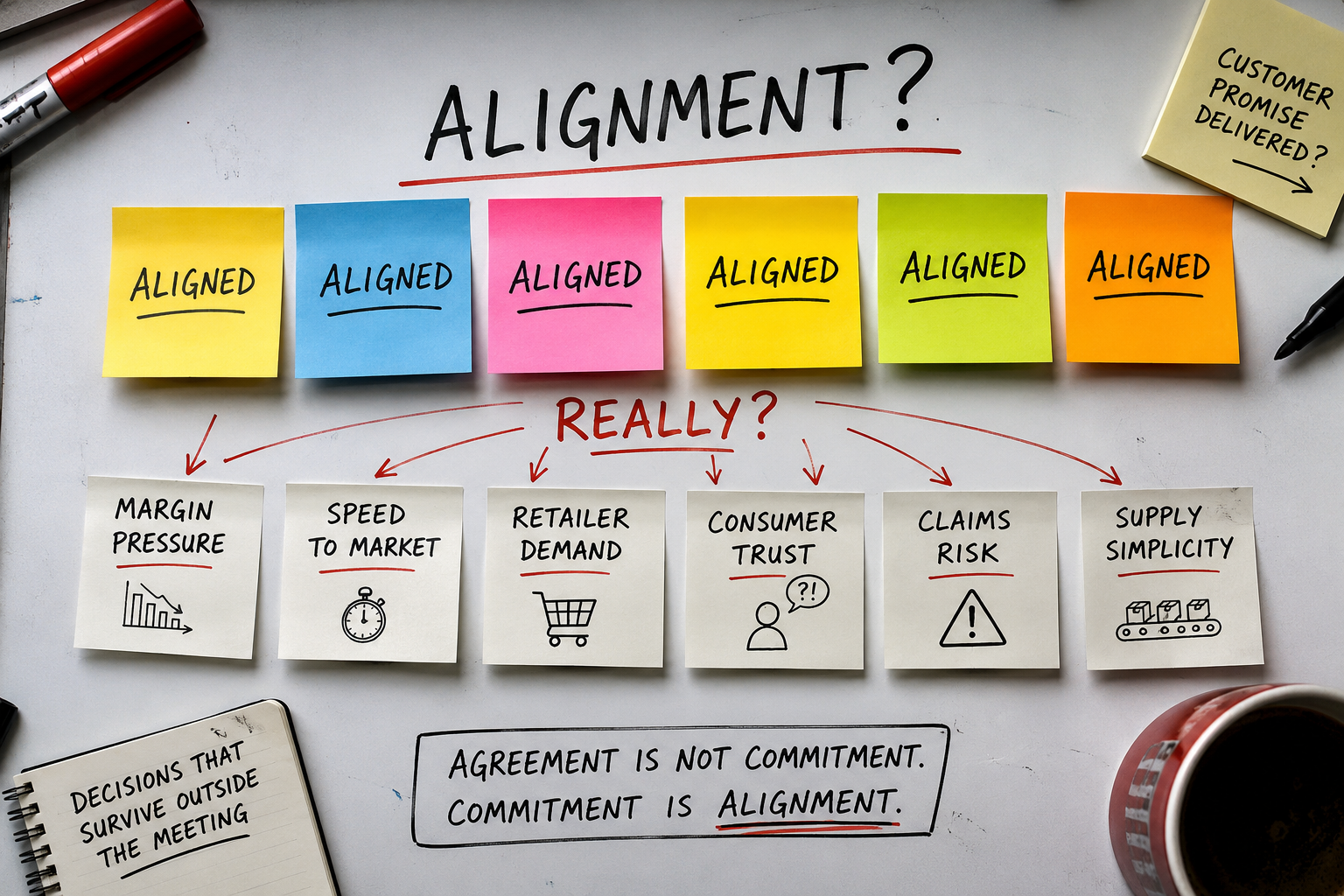
For mid-level managers, this is not a theoretical issue. They are often the people asked to “get everyone aligned” when what the business really needs is a decision about which priority wins. Marketing is protecting the brand idea. Sales is worried about the retailer. Finance is watching margin. Supply wants fewer exceptions. Legal is guarding risk. Insights is trying to keep the consumer evidence honest. Each function has a legitimate reason for its position, but the plan weakens when those tensions stay hidden behind polite agreement.
QC2™ is useful here because it tests whether alignment exists where it matters: across the company, the customer or consumer, the brand and the processes that make delivery possible. If those four areas are not connected, alignment becomes theatre. The meeting may feel smooth, but the customer, the retailer, the shelf or the service team will eventually find the gap.
Alignment is where too many good CPG ideas go to lose their edge.
Not all at once. That would be easier to spot. They lose it gradually, one reasonable comment at a time, until the original idea has been softened, resized, risk-managed and pre-approved into something nobody hates and nobody would defend with much energy.
That is the quiet damage.
A sharper claim becomes safer. A consumer-led innovation becomes operationally convenient. A customer experience improvement becomes a pilot with no teeth. A portfolio decision becomes a political compromise. A pricing move becomes a spreadsheet answer to a human trust problem. A brand idea that had some tension in it becomes “broadly acceptable,” which is often the most polite way of saying forgettable.
Nobody sets out to do this. That’s the uncomfortable part. The people in the room are usually competent, experienced and under pressure. They’re not trying to sabotage the work, they’re just doing what their functions reward them for doing:
- Sales protects the customer relationship because the buyer will be the one on the phone first.
- Finance protects margin because someone has to.
- Supply protects simplicity because every exception that looks manageable in PowerPoint becomes a real headache in production, forecasting and service.
- Legal protects the business from claims that could come back hard.
- Insights protects the consumer evidence from being stretched beyond what it can honestly support.
- Marketing protects the brand because if every function takes a slice out of the idea, there may be nothing left worth buying.
All legitimate. All necessary. And yet still, collectively, dangerous. Because when every function protects its own risk without anyone forcing the trade-off into the open, the final decision can become weaker than any one person intended. That is the part “alignment” often hides.
The meeting was (too) smooth. That may be the warning sign.
There is a particular kind of CPG meeting that looks successful from the outside. The pre-read went out on time. The right people were there. The discussion was polite. Nobody derailed the agenda. The project lead captured actions. The senior person at the end said, “Good, sounds like we’re aligned.”
Everyone leaves relieved, but that relief should make you suspicious.
Real alignment is rarely that neat when the decision matters. If the plan touches price, pack, claims, supply, retailer support, market execution, service response or brand trust, someone should feel the trade-off. Maybe more than one person. If nobody feels it, there is a fair chance the team has stayed at the level of broad intention rather than the actual choice.
It’s easy to agree that the brand needs to grow, but it’s much harder to agree whether growth should come from penetration, premiumisation, improved availability, range simplification, sharper claims, better retailer execution, more investment behind fewer SKUs, or fixing the repeat-purchase problem nobody wants to admit is serious.
It’s easy to agree that innovation needs to move faster., but it’s harder to decide whether the team will accept weaker evidence, higher supply risk, a less distinctive proposition, or a retailer conversation that may not go well.
It’s easy to agree that the company should become more customer-centric, but it’s harder to decide whose process has to change, whose budget has to move, whose metric has to be challenged, and whose pet project has to stop.
That’s where alignment becomes real. Not in the nodding, but rather in the sacrifice.
Most organisations don’t like that moment. They avoid it without admitting they are avoiding it. Another meeting appears. Another version of the deck gets requested. Someone asks for “a bit more input from Finance.” Someone else suggests pre-aligning with Legal “just to be safe.” Sales wants to “pressure-test with the customer team.” Supply asks for “one more feasibility pass.” Insights is asked to “add a stronger consumer angle,” which often means finding a way to make the evidence sound more certain than it is.
The machinery starts turning. People feel busy. The project appears to move. But the choice still has not been made. That’s how alignment becomes theatre: everyone is performing responsibility while the decision sits untouched in the middle of the room.
The middle gets handed the contradiction
Mid-level managers are the ones who usually inherit this mess.
They’re told to drive alignment, which sounds like a reasonable leadership expectation until you translate it into what actually happens. They have to:
- bring together functions with different incentives, different fears, different metrics and different degrees of power..
- keep the project moving without irritating the senior stakeholders.
- make sure everyone feels heard, even when half the comments are really attempts to avoid owning a risk.
- land a recommendation that is sharp enough to matter, but not so sharp that a powerful function blocks it.
This is why so many mid-level managers in CPG end up acting as corporate shock absorbers. They
- soften the conflict so the work can move.
- rewrite the deck so Finance sees its concern reflected.
- add a slide so Sales feels armed for the buyer.
- adjust the wording so Legal does not shut it down.
- keep the consumer insight visible enough for credibility, but not so visible that it becomes inconvenient.
- ask Supply for one more exception while pretending not to know how much goodwill has already been spent.
By Friday evening, the project is still alive, the stakeholder map is less hostile, and the manager is exhausted. Now that may look like progress and sometimes it is. But often it’s simply the cost of unresolved trade-offs being transferred to the person in the middle.
Then comes the predictable failure pattern. The launch underperforms, the retailer pushes back, the claim fails to cut through, the range change irritates loyal buyers, the customer service team cannot explain what has changed, or the process that was supposed to deliver the promise collapses under pressure. Suddenly, the same people who nodded in the meeting remember their concerns with great clarity:
- Sales says the customer risk was obvious.
- Finance says the margin issue was always a concern.
- Supply says complexity had been flagged.
- Legal says the claim was borderline from the start. Insights says the evidence was never strong enough.
- Marketing says the idea was diluted beyond recognition.
Everyone has a receipt. Nobody owns the outcome.
That’s fake alignment at its most expensive. It fails late, when the money has been spent and the middle manager is left explaining why a plan with apparent support did not survive contact with the market.
CPG doesn’t need more collaboration. It needs cleaner commitment.
There’s an assumption in business that collaboration is always good. It’s one of those beliefs nobody wants to challenge because the alternative sounds selfish, siloed and old-fashioned. But CPG is not short of collaboration. Many teams are in fact drowning in it.
There’s collaboration that improves decisions. Different functions bring different evidence, expose blind spots, sharpen the recommendation and leave with a clearer view of what must happen next. That kind is valuable.
Then there is collaboration as insurance. Collaboration as political cover. Collaboration as a delaying tactic. Collaboration as a way to make sure no one can later say they were not consulted.
This second version fills calendars and drains accountability. It creates meetings where people attend for “awareness,” which often means they say almost nothing during the session and then send comments later. It creates review cycles where every function improves its own safety position while nobody improves the whole decision. It creates sign-off chains so long that by the time the work is approved, the edge has gone and the market has moved.
The language always sounds reasonable, which is why it is hard to push back:
- “Could we just clarify the customer angle?”
- “Worth pressure-testing with Supply.”
- “Finance may need a tighter rationale.”
- “Legal will probably have a view.”
- “Let’s not surprise the market teams.”
- “Can we make the consumer benefit a little broader?”
None of those comments is automatically wrong. In fact, each may be sensible from the chair it comes from. But put enough of them together, and a clear recommendation becomes a diplomatic document. That’s when mid-level managers need to distinguish involvement from commitment. Involvement means people were asked.
Commitment means behaviours change:
- Sales agrees to carry the harder customer conversation because the consumer and brand logic are strong enough.
- Finance accepts that a short-term margin concern may be worth it if the alternative weakens trust.
- Supply agrees that some complexity deserves protection because it supports a priority product, customer or consumer need.
- Marketing accepts that a favourite idea is not landing and needs to be changed.
- Legal helps find language that protects the company without draining the claim of all meaning.
- Insights stops being treated as a slide provider and becomes the guardrail against wishful thinking.
That’s commitment. It has consequences. Alignment without consequences is usually just a nicer word for involvement.
Customers don’t care who signed off the deck
Internal misalignment rarely stays internal. It leaks into the customer and consumer experience, even when nobody calls it that.
A retailer feels it when the account team promises support that marketing has not funded properly. A shopper feels it when a pack has been changed to improve cost efficiency but now looks poorer value on shelf. A consumer feels it when a trusted product has been reformulated and nobody has explained why the experience feels different. A customer service team feels it when the brand message says reassurance, but the process only allows them to provide a scripted apology. A local market feels it when global sends a toolkit that looks beautiful and ignores the commercial reality of the channel.
The organisation may treat these as separate issues. A complaint here. A sales objection there. A weak launch. A retailer frustration. A consumer review that sounds harsher than expected. A service metric that moves the wrong way.
Often, they are not separate. They are symptoms of a decision that was aligned internally but not connected properly to reality.
This is the point CPG teams forget too easily: a plan can be internally aligned and still be externally wrong.
The leadership team can align around cost while the consumer experiences less value. The brand team can align around a cleaner identity while shoppers lose the cues they used to recognise the product quickly. The supply organisation can align around simplicity while retailers lose the range that made the fixture work. The digital team can align around lower service cost while customers feel abandoned.
The market does not care how many people signed off the work. The retailer does not care that the approval process was complex. The consumer does not care that the project team spent six weeks getting comments from twelve stakeholders.
They experience the output.
That is all.
The sentence that changes the meeting
There is one sentence more mid-level managers should learn to use:
We are aligned on the ambition, but not yet on the trade-off.
It is useful because it is calm and hard to dismiss. It does not accuse anyone of bad faith. It does not make the speaker sound negative. It simply points out that broad agreement and real commitment are not the same thing.
Use it when everyone agrees the brand needs stronger growth but nobody has decided whether to protect margin, invest behind penetration, simplify the range or fix availability first. Use it when the team agrees the claim should be more distinctive but Legal, Regulatory, Insights and Marketing are working from different definitions of acceptable proof. Use it when everyone supports simplification until the SKU being cut belongs to their market, customer or last year’s pet innovation. Use it when an AI project has enthusiasm but no clear owner, no decision it is meant to improve, and no agreement on what happens if the output is wrong.
The sentence works because it turns alignment from a mood into a test.
There are others worth using.
We have agreement in principle, but not commitment in behaviour.
The customer promise is clear, but the process will not deliver it.
The recommendation is acceptable to every function, but I am not convinced it is strong enough to change the result.
We have comments from everyone, but not a decision owner.
These are not disruptive statements. They are responsible ones. They do not create conflict; they reveal the conflict that was already there, which is very different. A manager who can do that without drama becomes more than the person chasing comments. They become the person protecting decision quality.
That reputation travels.
Real alignment has to survive after the meeting ends
Real alignment is not everyone liking the plan. That is a ridiculous standard anyway. If every function loves the recommendation, it may be because the recommendation is too vague to threaten anything important.
Real alignment means the decision is clear enough to survive outside the room. People know what has been decided and what has not. They understand which trade-off has been accepted. They know what each function will now do differently. They understand the customer or consumer risk. They know which process has to change to deliver the promise. They know who owns the consequence if the result disappoints.
That last point matters because “shared ownership” is often where accountability goes to die.
Shared ownership sounds collaborative in the meeting. Later, when results are poor, it becomes fog. The launch missed because the retailer did not support it. The claim was too weak because Legal was nervous. The pack arrived late because Supply had constraints. The concept was not clear because Insights did not push hard enough. The media was not enough because Finance cut the budget. The sales story was not strong enough because Marketing kept changing it.
Everyone explains. Nobody owns.
Real alignment forces some of that discomfort earlier, when it is still useful. It asks what the business is choosing not to do. It asks which customer may be disappointed, which consumer need is being prioritised, what risk is being accepted, what would make the team stop, and who has the authority to decide when the data is messy.
Those questions can slow a meeting down. Good.
Some meetings are moving too quickly toward false certainty.
How QC2™exposes disguised misalignment
QC2™ is useful because it doesn’y let alignment stay vague. It tests whether the company, the customer or consumer, the brand and the process are actually connected. Those four areas drift apart inside CPG companies all the time, usually while everyone insists the project is under control.
The company question asks whether the decision genuinely supports the growth ambition or mainly satisfies an internal pressure. That distinction matters because internal pressure often dresses itself as strategy. A portfolio cut may be called simplification when the real driver is short-term margin. A launch delay may be presented as quality discipline when unresolved ownership is the deeper issue. A customer experience initiative may be labelled transformation while the incentives that created the poor experience remain untouched.
The customer or consumer question cuts through internal logic. Does the decision reflect what people actually need, value, expect and experience? CPG teams can become very efficient at solving problems consumers barely recognise. They can perfect a claim shoppers do not understand, rationalise a range in a way that removes meaning, or automate a service process that reduces handling time while increasing frustration.
The brand question asks whether the decision strengthens or weakens the promise people associate with the business. This is where apparently sensible choices deserve more scrutiny. Smaller pack. Softer claim. Cheaper material. Fewer variants. Faster service. More automation. Each may make sense in isolation. Together they may make the brand feel less generous, less distinctive, less trustworthy or less worth the price.
The process question is the one that strips away fantasy. Can the organisation actually deliver what it has agreed, not once, not heroically, but repeatedly and across the markets, customers, channels and teams affected?
This is where meeting-room alignment often collapses. The slide says yes. The workflow says no. The data is patchy. The approval path is slow. The handover is unclear. The customer team does not have the material. The service team does not have the explanation. The local market does not have the budget. The agency does not have the decision rights. The process still rewards the old behaviour while the strategy asks for the new one.
QC2™ makes those gaps visible before they become commercial pain. It asks a tougher question than most alignment meetings ask: are we aligned where the customer will feel it, or only where the meeting could see it?
The career risk nobody spells out
Fake alignment is not only bad for the business. It is bad for the careers of the managers stuck managing it.
Mid-level managers can lose years becoming excellent at smoothing over organisational weakness. They become the person who can get the deck through, calm the stakeholder, rewrite the recommendation, chase the function, soften the objection and keep the project just alive enough to survive another review.
That ability is useful, but it’s also dangerous.
A safe pair of hands is often given more work, not more power. The manager becomes known for getting things through the system rather than improving what the system decides. They are trusted to absorb complexity, but not always invited to question whether the complexity should exist. They are praised for being collaborative while the unresolved trade-offs remain above or around them. That’s a career ceiling disguised as a compliment.
In leaner, faster and more AI-supported CPG organisations, this matters even more. AI can already take over parts of coordination: summaries, reminders, first drafts, meeting notes, document comparisons, action tracking and status updates. The manager whose value is mainly coordination will find that value harder to defend over time.
The manager who can expose weak alignment early, connect functional tension to customer consequence and help the organisation make cleaner choices is playing a different game.
That is not about being loud. Loud people can waste a room as efficiently as quiet ones. It is about precision. It is the ability to name what is unresolved without turning the meeting into a fight, to separate a real objection from political hesitation, to protect the consumer or customer consequence when internal priorities start crowding it out.
That’s leadership of the useful kind.
A better test before anyone says “we’re aligned”
Before a team uses the word alignment, it should be able to pass a few tests.
What exactly has been decided? What has been sacrificed or risked? What will each function do differently now? Where could the customer or consumer still feel a gap? Does this strengthen or weaken what people believe about the brand? What has changed so delivery becomes possible without personal heroics? Who carries the consequence if results disappoint?
These questions do not need a ceremonial workshop. They can be asked in a meeting, in a pre-read, in a one-to-one with a stakeholder, or in the quiet moment before the team rushes toward another approval.
They work because they are concrete. They make it harder for people to hide behind pleasant agreement. They also give mid-level managers a way to challenge without making the conversation personal.
That matters. CPG is political enough without adding theatre. The goal is not to make people uncomfortable for sport. The goal is to stop the business spending months discovering what it refused to discuss at the start.
Work With C3Centricity
If your organisation spends too much time aligning and not enough time changing what happens for customers and consumers, the issue may be deeper than communication.
QC2™ helps diagnose where customer-centric growth is breaking down across the company, the customer or consumer, the brand and the processes that support delivery. It shows whether the business is genuinely connected where it matters, or whether alignment is being used to cover gaps that will eventually show up in growth, customer experience, retailer trust or brand performance.
Take the free QC2™ Business Assessment to see where misalignment may be slowing growth, weakening customer experience or making your brand promise harder to deliver.