Why You Must Amplify Your Impact in 2026, because it matters more than it did five years ago.
Executive Summary
Ask any mid-level manager what got them noticed last year, and most will describe how hard they worked. That’s the tell.
For a long time, effort was the story that got people promoted. A packed diary showed a reputation for never dropping the ball. Under pressure, the person who everyone could rely on carried teams forward. Managers noticed the effort, and promotions followed.
That combination used to carry people up the ladder in CPG, aligning with Career strategy. Some teams attribute slower growth to inconsistent effort, while others credit steady reliability. In practice, this approach shapes how leaders assess readiness for bigger roles.
Reliability read as proof of value, or close enough that nobody looked too hard. Over time, teams learned to value consistency over flashy results. That mindset became part of how teams plan growth. The emphasis on consistency shaped leadership decisions for years.
Microsoft’s 2025 Work Trend Index surveyed 31,000 people across 31 countries and found the gap opening up. 53% of leaders say productivity has to go up, while 80% of the workforce says it doesn’t have the time or energy to make that happen. The same report clocked something else: employees get interrupted by a meeting, an email, or a chat every two minutes during the workday.
Effort, in other words, isn’t proof of anything. Not anymore. In fact I don’t think it has been for many years.
Prefer to listen rather than read?

The Excuse is Now Running Out
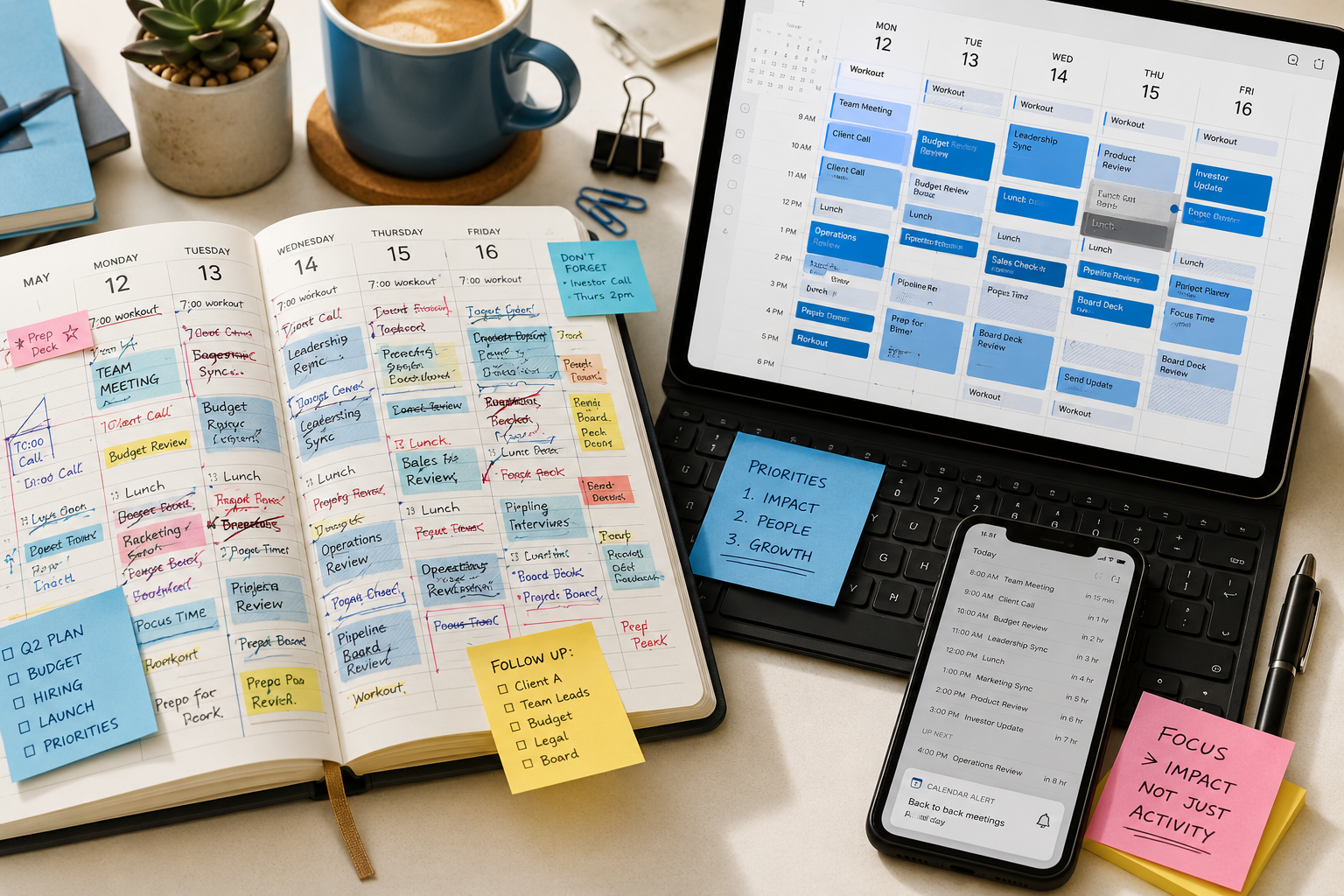
Mid-level managers in CPG could once point to their full agenda as evidence of their value. Retailer meeting at 9, an innovation review at 10, a claims discussion before lunch, a global deck rewrite by evening. Everyone was doing something. Nobody had time to ask whether their particular something actually mattered.
AI is now slowly closing that excuse down, one task at a time. It drafts the first version of a retailer update. It summarizes consumer reviews. And it turns a two-hour Teams / Zoom call into a one-page action list.
Deloitte’s 2026 Consumer Products Industry Outlook put it painfully clearly. Product managers could adopt a Career strategy that makes them entrepreneurial, consumer-obsessed creators. That work has consumed their days for the last ten to twenty years. Once AI takes the technocratic marketing work off their plate, it frees days.
That’s the opportunity for your Career strategy.
But it’s also the threat.
If AI removes the coordination work that made you look busy, what’s left to prove?
Are you still valuable to the company otherwise?
Nobody is going to reward you for drafting the retailer update faster.
They’re going to notice what you do with the hour that drafting used to take.
Meetings are where fake impact hides best
A meeting that changes a decision is worth having. A meeting that exists because nobody has made the decision clear enough is a different animal entirely, and CPG calendars are full of the second kind.
Shopify found this out the hard way, then did something about it. At the start of 2023, the company canceled 12,000 recurring meetings involving three or more people and brought back “no-meeting Wednesdays.” By its own count, that freed up 322,000 hours across the year. Average meeting time per person dropped 14% in the first five months compared with the year before; on Wednesdays specifically, it dropped 26%. Most of those 12,000 meetings were never rebuilt. Nobody had missed them.
Shopify isn’t a CPG company, and the lesson isn’t “delete your calendar.” The lesson is that time has a cost most organizations never make visible. CPG teams know exactly what a late shipment costs, or a packaging change, or a retailer penalty. They rarely know what eight people spending three weeks circling an undecided issue costs. That’s where impact quietly leaks away.
When busy gets mistaken for value
CPG has its own version of this mistake, and it cost billions to learn.
When Kraft and Heinz merged in 2015, the new leadership rolled out zero-based budgeting across the business: every dollar had to be justified from zero, not carried forward from last year’s plan. On paper, it moved fast. Overhead dropped from roughly 18% to 11% within about fifteen months. Meetings were full of cost discussion. Spreadsheets multiplied. Everyone could point to a number moving the right way.
By February 2019, the company took a $15.4 billion write-down on its Kraft and Oscar Mayer brands. The stock fell 27% in a single day. The cost-cutting had been real and measurable. What it left behind wasn’t: under-invested brands, strained supplier relationships, and a business that had gotten leaner without getting stronger.
Nobody at Kraft Heinz was accused of being lazy. The opposite. The organization was busy proving efficiency, meeting by meeting, spreadsheet by spreadsheet, while the harder judgment call, how much a brand actually needed to stay competitive, went unmade. Activity had a number attached to it. Impact didn’t, until it showed up as a $15 billion write-down.
What Amplify Your Impact actually means
It doesn’t mean self-promotion, and that distinction matters, because plenty of strong managers recoil from anything that smells like personal marketing.
It means the value you create travels further than the hours you put into creating it. A decision gets sharper because you clarified the real issue. A junior colleague grows because you handed over judgment instead of quietly redoing their work. A senior leader trusts your recommendation because you connected the consumer, the retailer, and the business consequence in one clear line.
Impact isn’t volume. It’s the gap between what would have happened without you and what happened because you were there.
This is why Amplify Your Impact sits inside LADDERS as its own rung, not a footnote under the others. Mid-level CPG managers are often the most valuable people in the building and the least visible. They’re over-used because they’re reliable, under-seen because reliability doesn’t announce itself, and badly positioned because nobody ever taught them that visibility is a skill, not a personality trait. The rung exists because that combination, valuable, invisible, exhausted, is exactly where careers stall.
Five signs your week is full but your impact isn’t growing
• You’re in meetings for context, not for judgment.
• You spend more time preparing updates than shaping decisions.
• Your team leans on you to absorb complexity, not to question whether it’s necessary.
• People are grateful for your help, but no more capable because of it.
• You end the week exhausted and can’t name one decision that improved because you were in the room.
None of that makes you a bad manager. It makes you a manager working inside a system that rewards responsiveness, then quietly penalizes the people who get consumed by it. The risk is staying there too long, especially as AI takes over more of the coordination work that used to keep you busy, and busy stops being enough.
Where to start
Not with a new productivity system. With one week, watched honestly.
Look at your calendar: which meetings changed a decision, not which ones felt useful? Look at your team: who became more capable because of something you did, not something you did for them? Look at your influence: does it travel to rooms you’re not in?
Those questions sting a little. They’re supposed to.
Write down what you find, even the uncomfortable parts. Most managers already know, in the back of their mind, whether last week was full of judgment or full of noise. The value isn’t in the discovery. It’s in doing one thing differently the following week: saying no to a meeting that doesn’t need you, handing a piece of work to someone who’ll grow from doing it, or walking into one conversation with a recommendation instead of an update.
Find out where your impact is stuck
The LADDERS™ leadership assessment takes just ten minutes to complete and shows you exactly which of the seven leadership rungs is holding your career back, including whether working to Amplify Your Impact is the one to strengthen first.
Take the LADDERS™ quiz → https://c3centricity.com/leadership_assessment/