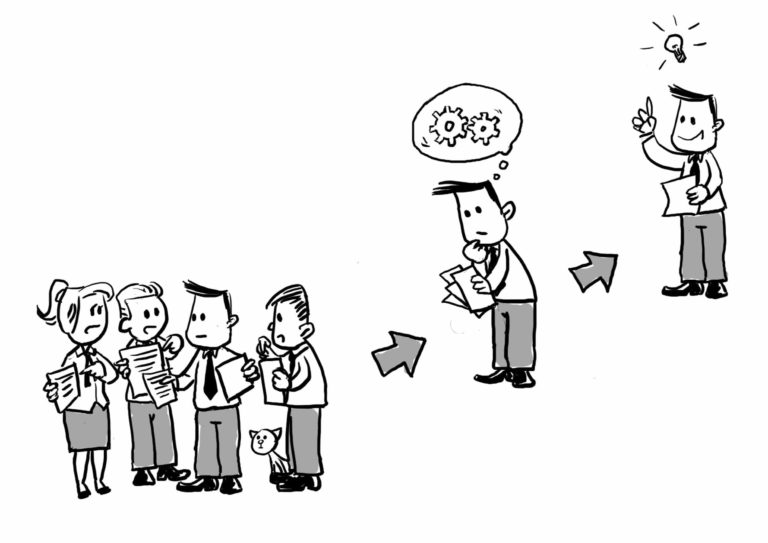

Executive Summary
Most organisations are not short on answers, they’re short on properly defined problems.
That may sound obvious, but it becomes much less obvious once a real business issue lands on the table and half a dozen experienced managers start trying to solve it. Sales softens, so the immediate conversation turns to promotion or price. A new product under-performs, and Marketing starts talking about awareness. Complaints rise, and Customer Service wants to rewrite the script. Margin slips, and Finance wants savings. Everybody is busy, everybody has a view, and the meeting quickly fills with proposed actions.
The awkward question is whether anyone has established what is actually wrong.
I was reminded of this recently while working with the leadership team of a beverage company in West Africa. I had built a fictional commercial case for them around a possible new drink, giving them enough facts to make the situation feel real, but not enough to make the answer obvious. The point was not to see who could come up with the smartest recommendation fastest. It was to see whether they could resist the urge to recommend anything at all until they had separated what they genuinely knew from what they were assuming.
That sounds simple. It wasn’t!
Experienced managers are very good at recognising patterns, and that is both a strength and a risk. Once you have seen dozens of launches, retailer negotiations, pricing problems and consumer shifts, you begin to think you know what a familiar-looking situation means. Often you do. Sometimes you don’t. The expensive mistakes usually happen when confidence arrives before diagnosis.
There is plenty of evidence that companies struggle with this. PwC has reported that 57% of executives believe they are missing opportunities because their organisations cannot make decisions quickly enough, while Deloitte’s 2026 work on decision-making found that 57% of organisations still operate at low decision-making maturity and only 5% consider themselves leaders.
Speed matters. Of course it does. Nobody running a business wants to spend three months studying a problem that should have been resolved in three days. But speed only helps when the problem has been framed correctly. Move quickly on the wrong diagnosis, and all you have done is reach the wrong answer sooner.
That is why good problem solving in business starts before the solution. It starts with the discipline to ask what is known, what is assumed, what is missing, and which of those gaps could genuinely change the decision.
Why Problem Solving in Business Goes Wrong Before the Solution Starts
Most managers are trained, formally or otherwise, to be useful. Useful people give answers. They may make recommendations and move things forward, but they don’t usually win admiration by saying, “I’m not sure we understand the problem yet.”
That creates a bias towards action, and in many businesses the bias gets stronger the more senior someone becomes. Senior managers are expected to recognise patterns quickly. They have history. They have scar tissue. They remember what happened the last time a retailer pushed back, or when a particular category slowed, or when a launch struggled because the proposition was too complicated.
Experience is valuable precisely because it gives us shortcuts. The problem comes when the shortcut becomes the diagnosis.
A drop in sales after a price increase may look like a price problem, but perhaps the increase coincided with weaker distribution, a competitor promotion, a pack change, lower media support or simply a seasonal effect the team has ignored. A weak launch may look like an awareness issue, but awareness may be perfectly healthy while repeat purchase is poor. A rise in complaints may point to product quality, but it may also be caused by packaging, unclear instructions, service failure or an expectation the brand itself created.
The same symptom can support several explanations, and each explanation sends the business in a different direction.
That’s where money disappears. If the team decides the issue is awareness, they buy media. If the issue is value, they change price. If they decide that the issue is distribution, Sales gets involved. And when they see the issue is in product experience, R&D or Operations gets dragged in.
But if the issue is relevance, the problem may be much bigger than any of those individually. A wrong diagnosis followed by excellent execution is still a wrong decision. It is just a more expensive one.
Problem Definition Gets Harder When Assumptions Start Sounding Like Facts
The beverage exercise I used with a recent client was deliberately designed to encourage premature certainty.
The fictional company had seen its traditional soft drinks grow more slowly than the market for two years. Locally inspired drinks were gaining visibility. 62% of younger consumers in an exploratory study said they wanted to try new flavours, while 57% of retailers reported customers asking for less sugar.
The new concept looked attractive on paper. Hibiscus, lime and mild ginger, with a distinctive baobab-flower aroma. Sugar was 20% lower than the company’s standard sodas. International competitors were mostly playing in familiar global flavours, so there appeared to be some open space.
At that point, most people can already feel the answer forming. Local tastes are gaining. Young consumers want novelty. People are asking for less sugar. Competitors have not claimed the territory. Launch it. Except none of those facts proves that conclusion.
Traditional sodas growing more slowly than the market tells us something has changed, but not why. Consumers saying they want new flavours tells us they are open to novelty in principle, not that they will buy this particular flavour combination twice. Retailers reporting requests for less sugar is interesting, but it does not tell us how often that request occurs, which consumers make it, whether it influences purchase, or what they are willing to sacrifice in taste to get it.
Anyone who has spent time in innovation knows how seductive “interest” can be. People love saying they would try something new. They also love saying they want healthier choices, more sustainable packaging and simpler ingredients. None of that automatically translates into repeat purchase once the product is in front of them and money has to leave their wallet.
Then came one of the less glamorous facts in the case: refrigeration was not always reliable in some outlets because of electricity interruptions.
That one operational detail could turn out to matter more than the entire flavour story.
If the drink only tastes good properly chilled, then the business may be building a concept around an experience it cannot consistently deliver. The most attractive consumer insight in the world will not rescue a product that tastes disappointing under normal market conditions.
That is why problem definition has to come before enthusiasm. Facts tell you where to look. They do not tell you what conclusion to draw.
Business Decision Making Changes Depending on Who Is in the Room
Put the same commercial problem in front of different functions and you will get different diagnoses, because people naturally see the issue through the part of the business they understand best.
Sales will notice distribution and retailer reaction. Marketing will look at the proposition, communication or brand fit. Finance will question economics. Operations will see complexity and feasibility. Insights will worry about the quality of the evidence. R&D will focus on what can actually be made.
Nobody is necessarily wrong. That is what makes the conversation difficult.
The danger starts when one function’s view becomes the default simply because that function has the loudest voice, the strongest senior sponsor, or the metric everyone happens to be watching that quarter.
I see this regularly in client companies. Sales says the price is too high because the buyer is pushing back. Marketing says the proposition is not being understood. Finance says lowering the price destroys margin. Supply chain says that costs can’t come down without changing the product or pack. Consumer insights points out that nobody has actually spoken to consumers who rejected the product. Before long, five departments are solving five different problems.
Mid-level managers usually sit right in the middle of that mess. They’re close enough to the customer, consumer and operational details to know the situation is more complicated than the headline, but they’re also under pressure to move things forward because senior management wants a recommendation. This is where judgement matters more than confidence.
The useful manager is not always the one who speaks up first. It’s often the one who notices that the room has already started debating solutions before anybody has agreed on what is actually causing the problem.
Gartner’s 2025 research on what it calls “strategic dysfunction” is relevant here. 84% of CMOs surveyed reported high levels of dysfunction caused by unclear, excessive or conflicting enterprise objectives, and organisations with high strategic dysfunction were 36% less likely to report strong business and marketing performance.
Sometimes the problem isn’t that the team lacks information; it’s that different functions are solving for different definitions of success.
Decision Quality Suffers When Speed Turns Into Premature Certainty
Business has become obsessed with speed, often for good reason. After all, we’ve all become impatient with the increasing speed of online information and availability, haven’t we? Markets move quickly, customers are less patient, technology changes assumptions almost overnight, and competitors do not wait politely while an internal team completes another review cycle.
Nobody needs more bureaucracy. But there’s a difference between making decisions faster and reaching conclusions faster, and companies often confuse the two.
Good problem definition need not take weeks. Sometimes the entire conversation changes because one person asks a basic question that nobody else thought was worth asking.
Imagine someone says, “Customers are leaving because of price.” The obvious response is to discuss price. The better response is: How do we know?
Perhaps sales dropped immediately after the increase. Fine. What else changed at the same time? Distribution? Competitor activity? Pack size? Formula? Promotion support? Shelf position? Seasonality? Very quickly, a tidy story becomes messier.
Managers sometimes resist this because it feels like slowing things down. It’s not. It’s spending a few minutes now to avoid wasting six months later.
The most expensive mistakes I’ve seen in business were rarely caused by managers having absolutely no information. They happened because someone became certain before the evidence deserved that certainty.
More Data Does Not Automatically Improve Business Problem Diagnosis
Companies have spent years pushing managers to become more data-driven, which is sensible until “data-driven” becomes shorthand for “there’s a dashboard, therefore we understand the situation.”
Dashboards are seductive because they look objective. There are percentages, trend lines, colour coding, precise figures and arrows telling you which direction something is moving. What they do not necessarily tell you is why.
TheyDo’s 2025 leadership research found that 77% of executives relied on dashboards but only sometimes or rarely questioned the data they were receiving. Half said they felt overwhelmed by the amount of data and dashboards, while 34% said they didn’t have enough time to analyse that data effectively. The distinction between evidence and diagnosis is easy to lose.
Sales data may tell you where volume fell, but not why a retailer reduced facings. Customer service data may tell you how many complaints came in, but not how many people quietly gave up without complaining. (It can be as much as 20 times higher!) Website analytics may show where people abandoned a journey, but not whether they were confused, unconvinced, distracted or comparing alternatives. Those numbers matter, but they don’t relieve managers of the need to think.
Good business problem diagnosis uses data as evidence, not as an excuse to stop asking questions.
AI Has Made Critical Thinking for Managers More Important
AI has made this issue more pressing because it can produce a plausible answer to almost any question in seconds. That’s incredibly useful. It’s also incredibly dangerous when the question is wrong.
Ask an AI system to explain why a product is losing share, and it will happily generate a set of possibilities. Give it sales data, research transcripts, competitor information and customer feedback, and it will produce something that looks impressively complete. But the quality of the output still depends on the frame you give it.
Deloitte’s 2026 Human Capital Trends research found that 60% of executives were already using AI regularly to support decisions, while its broader work on decision maturity showed that 57% of organisations remained at low levels of maturity and only 5% considered themselves leaders.
AI can help analyse price elasticity, review complaints, compare claims, interrogate transcripts and identify patterns across large amounts of information. Used well, it is a terrific assistant. But someone still needs to decide whether price elasticity is the issue worth investigating:
- Is a small group of complaints comes from a very valuable customer segment?
- Is the competitor set being analysed actually the one consumers use?
- Does the company keep asking how to sell more of something people no longer need in quite the same way?
Those are not data-processing tasks, they’re framing decisions. The smarter AI becomes, the more important that distinction becomes.
Better Problem Solving Starts With Facts, Then Questions
The discipline I am using with my current client is deliberately uncomplicated. Start with what is genuinely known.
Not what everybody around the table believes, nor what “we’ve always understood about this market,” nor what the commercial director heard from three customers last week and has repeated so often that it now sounds like research.
Facts first. Then ask what those facts make you curious about. That’s where the conversation changes.
If traditional soda sales are growing more slowly than the market, don’t immediately assume that the company needs innovation. Find out where the gap sits first. Which channels, which regions, on which occasions, and which consumer groups? Are people switching brands, switching categories, drinking less often or simply buying differently? Those are the questions you need to answer first.
If retailers say people are asking for less sugar, find out who those people are, how often the issue comes up, whether it changes purchase behaviour and what they mean by “less sugar.”
If younger consumers say they want new flavours, explore what sort of novelty they actually enjoy, what crosses the line into strange, what they are willing to pay, and whether the purchase is individual, social or occasion-driven.
None of those questions is clever for the sake of being clever. They simply expose the distance between what the business knows and what it has begun to assume.
Good Problem Definition Includes Knowing What You Don’t Know
This is the point where some managers become uncomfortable, because admitting what you don’t know can feel like weakness. But it’s not. A strong manager should know where the evidence ends.
Before I would recommend a national launch for the fictional beverage company, I would want to understand taste acceptance beyond employees, likely repeat, price sensitivity, retailer economics, performance when the product is not properly chilled, ingredient reliability, competitive reaction, relevant occasions and whether the local identity creates real preference or just initial curiosity.
I would also want to know whether the business can deliver consistently. A good concept with unstable ingredients, poor distribution or unreliable cold availability isn’t a good business proposition. But that also doesn’t mean you have to research everything.
This is where rigour can become bureaucracy, if managers aren’t careful. The goal is not perfect knowledge, it’s to identify the unknowns that could change the decision. If an answer would make no difference to what you do, stop researching it. But if an answer could move you from launch to adjust, or from adjust to stop, then it matters. That’s the discipline that is worth adopting.
Customer-Centric Decision Making Starts Before the Recommendation
Eventually, the business still has to decide. For the beverage case, the recommendation has only a few realistic destinations. Launch it. Adjust it. Stop it. Simple enough. Everything before that exists to make one of those decisions better.
Companies often get this process backwards because by the time research and analysis arrive, the organisation has already fallen in love with the answer. Senior management likes the idea. Money has been spent. Somebody has already talked about the launch date. Teams have invested months of work and do not particularly want to hear that the concept may need to change.
At that point, research quietly becomes proof-shopping. The question shifts from “Should we do this?” to “What do we need to know to make this work?” That change is subtle, but it matters enormously.
A genuinely customer-centric decision process has to leave room for an answer the organisation does not want. Sometimes the answer is to adjust, sometimes to wait, and sometimes the right answer is to stop.
Managers often talk about the cost of killing a project after money has been invested. They talk less about the cost of continuing because nobody wants to admit the original diagnosis was weak. Stopping early isn’t failure. Spending another few million because the company has become emotionally attached to its own idea is much closer to it.
How Other Companies Are Building Better Decision Quality
This kind of decision practice is not limited to CPG. Deloitte’s 2026 research describes how BAE Systems has used case-based learning with leaders, giving them realistic, ambiguous situations where they have to work with incomplete information, decide what evidence they trust and frame hypotheses before acting. Deloitte reports early feedback showing stronger cross-functional coordination and faster, more confident decisions.
I find that approach interesting because it recognises something leadership training often forgets: you can’t learn judgement entirely from theory. Managers get better at judgement by using it in situations where the answer is not obvious, where evidence conflicts, where different functions see the same facts differently and where somebody still has to make the call. That’s much closer to real business than another model on a slide.
Real problems do not arrive neatly framed with all the relevant data attached. If only they did!
How QC2™ Improves Business Problem Diagnosis
QC2™ exists because business problems rarely sit inside one function. It asks managers to look at the company, the customer or consumer, the brand and the processes that connect the promise to delivery. Those four perspectives matter because a problem that looks straightforward through one of them can look completely different through another.
For example, take a sales decline. Viewed from company performance alone, it may appear to be a pricing or distribution problem. But viewed through the eyes of the consumer, it may be a relevance problem. Viewed through the brand, it may reflect a weakening point of difference, but viewed through the lens of internal processes, the issue may be that the right products are simply not available consistently enough in the places where demand exists. Same decline. Different diagnosis.
That’s the practical value of QC2™. It doesn’t give managers a tidy answer. It stops them from settling too quickly for the answer that happens to be most comfortable from their own functional perspective.
That’s also why I’ve been using applied cases with the managers I am currently supporting. Watching content has value. Workbooks have value. But the real development begins when managers have to decide which facts matter, challenge an assumption that sounded perfectly sensible five minutes earlier and explain what they still need to know before putting money behind a recommendation.
That’s when a framework becomes useful rather than decorative.
One Question That Can Improve Your Next Business Decision
The next time someone brings a problem into a meeting and the room immediately starts producing solutions, resist joining in for a few minutes. Ask one question first: “What do we actually know?”
Then listen carefully to the answer, because assumptions will start slipping into the conversation almost immediately. Separate them. Ask what else could explain the same facts. Work out what is missing and which missing information could genuinely change the decision. Only then start talking about what to do.
This doesn’t require an off-site, another committee or a forty-page presentation. It simply requires somebody in the room to tolerate a little uncertainty before everyone rushes towards the comfort of action.
That can feel slow, but it is usually much faster than fixing the wrong problem!
Ready to Strengthen the Way Your Team Makes Decisions?
If your organisation is very good at generating answers but less disciplined about making sure it is answering the right question, the Business Accelerator™ is designed to help managers change the way those decisions get made.
The programme takes customer centricity out of the realm of theory and applies it to the decisions managers deal with every day: understanding what customers and consumers are actually experiencing, challenging assumptions before they harden into “facts,” using QC2™ to connect company, customer, brands and processes, and turning that understanding into action the business can actually deliver.
It is fully online, which means managers can work through it at their own pace and apply the thinking immediately to live business issues rather than waiting for the next workshop.
And the Business Accelerator™ programme is now available in both English and French. If you need another language, it can be delivered within a week or two, so don’t let that stop you or your team from learning the very best way to grow the business faster than before.
If your team has a habit of moving from problem to solution too quickly, the most useful place to start may be the space in between.