Executive summary
Customer journey mapping is one of the most popular tools in brand management and customer experience, and yet it is also one of the most underused.
Companies invest in solid research, agree on the pain points, and print the map large enough to cover a wall. But months later, customers still hit the same problems.
Forrester argued in June 2026 that journeys need to become “decision systems” that shape priorities, funding, and delivery. They gave the example of a bank’s onboarding that took 30 days because risk, IT and sales each optimized their own part. Nobody had designed the wait; the customer simply endured it.
For CPG companies, most pain points start far from the CX team—in forecasting, pack design, retailer negotiations, or a cost-saving formula change. This article shows how to place those business decisions—and the brand promise—beside each key customer moment, and how QC2™ can diagnose what drives the journey.
Prefer to listen?

I’ve lost count of the customer journey maps I’ve seen over the years. Many were excellent: built on solid research and detailed enough to show what customers were trying to do, where they struggled, and how they felt along the way.
The trouble with a good map is the comfort it brings. People gather round it, discuss the red pain points, agree on the moments that matter and nod at the obvious fixes. They circulate the finished version, upload it to the research portal, and occasionally enlarge it to cover a meeting-room wall. Then comes the awkward question. What actually changed?
Forrester has been asking much the same thing. In January 2026, its analyst Joana de Quintanilha wrote that customer journeys “are becoming management operating systems”, drawing on interviews with 30 buyers across industries for its 2026 buyer’s guide. Where journey data isn’t connected to operational and financial data, she noted, “ROI remains anecdotal and slow.”
A June 2026 follow-up went further, arguing that journeys left inside CX teams rarely shape the priorities, funding or delivery decisions that determine what customers actually experience. I think that’s a healthy correction. A journey map earns its keep when the business behind the experience changes.
Customer journey mapping makes reality look tidier than it usually is.
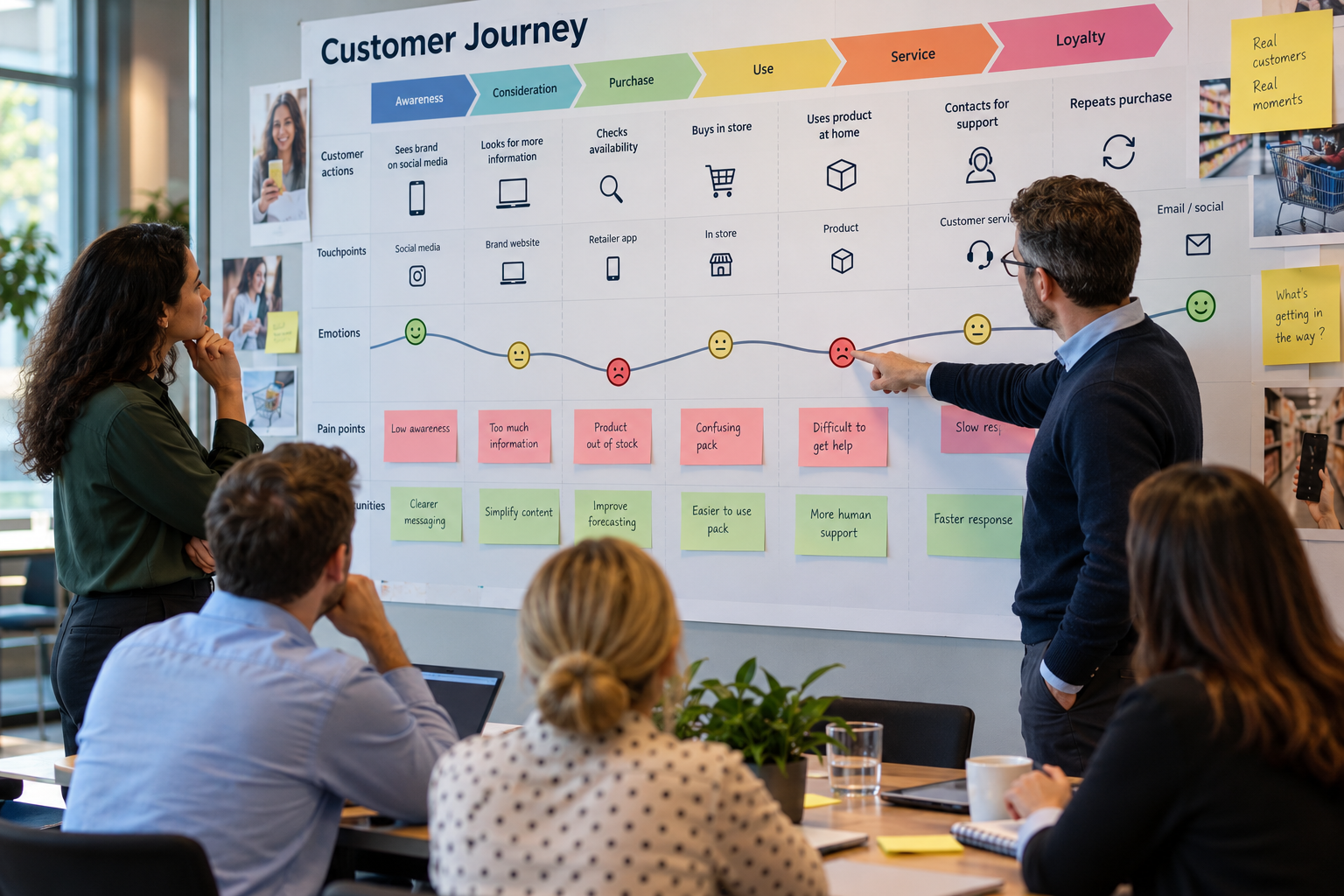
After all, every map simplifies reality. It has to, or nobody could use it effectively. Awareness leads to consideration, purchase leads to use, and eventually the customer arrives at repeat purchase or loyalty. The stages vary by category, but the logic normally fits neatly across a page.
However, our consumers show our diagrams very little respect. Someone sees a food brand on Instagram, checks the ingredients on its website, searches a retailer app for availability, buys in store, struggles with the pack at home, and messages the brand on social media.
To that consumer, it’s just one relationship with the brand. But inside the company, that short journey may have touched media, ecommerce, regulatory, sales, the retailer, packaging development, consumer services and an outside agency running the social channels.
Every handover risks losing context. Genesys’s State of Customer Experience report, released in July 2026 and based on 5,811 consumers and 1,560 CX and business leaders, found that 48% of companies don’t pass information customers have already shared on to a human agent. The same research found that 85% of consumers had spent less, or stopped buying altogether, after a poor experience.
The information exists somewhere inside those companies. It’s lost when the customer moves from one part of the system to the next, and customer journey mapping can show that moment perfectly without doing anything to repair it.
The red dot is where the work starts
Picture a shopper who reaches checkout on a retailer’s website and finds that a product shown as available can’t be ordered. Mapping that is easy. The customer expected to buy, hit a stock problem, and left annoyed.
The useful questions are far less photogenic:
- How often is the inventory data refreshed?
- Does the retailer apply different availability rules online and in store?
- Did a promotion pull demand forward faster than planned?
- Has the manufacturer allocated scarce stock elsewhere?
- Does anyone ever put complaints next to supply data so the pattern becomes visible?
This matters enormously in CPG, because so many critical moments are controlled by people who never see a journey map. Availability depends on forecasting, sales and retailer execution. A confusing claim may trace back to regulatory, marketing and pack design. A disappointing product can start with a formula change made to solve a cost or supply problem.
The consumer sees the result only after all those decisions have been made. A map that stops at “availability problem” or “confusing pack” describes what happened, but it says very little about why.
The 30-day journey nobody designed
Forrester’s June 2026 piece includes an example I wish every leadership team would read. It describes a bank where onboarding a new customer took 30 days. Nobody had decided that customers should wait a month. Risk had optimized its process, IT had optimized its part, and sales had done the same. But the customer experienced the combined result.
Once leaders looked at the journey end to end, they set a very different goal: two days instead of 30.
It’s a banking story, but I recognise it from every CPG company I’ve worked with. A poor experience can emerge during customer journey mapping when no one makes an obviously poor decision. Each function improves what it controls, and the customer inherits the sum.
Had the bank stopped at mapping the frustration of onboarding, it would have produced an accurate picture of impatience. The real management work began when someone asked why 30 days existed at all. The unhappy face on the map is evidence; the diagnosis comes afterwards, and that’s the step most customer journey mapping leaves out.
How DBS took the journey off the wall
DBS, the Singapore-based bank, shows what happens when journeys become part of how a business is run. Its approach, called “Managing Through Journeys,” brings together people from every function that affects a customer journey, from start to finish.
According to an IMD case study published in December 2024, DBS piloted a few of these in 2021, and by 2024 more than 60 were running, covering over 60% of the bank’s revenues. Each team shares a common set of KPIs.
The scale is impressive, but the principle matters more. A map can reveal that five departments shape the same experience; DBS asked those departments to own the result together.
I wouldn’t suggest a food or beauty company copy a Singaporean bank’s organisation chart. What’s worth borrowing is the willingness to treat the journey as a management issue. Once you do, a much harder question follows: who has the authority to change the decisions creating the pain point?
When the map gets too big to use
Another trap I’ve seen is when customer journey mapping becomes established.
The team wants the map to be complete. Another touchpoint gets added, then another persona needs its own version. Online and offline journeys split. Each market wants its own. Before long, the map is impressively thorough and almost impossible to prioritize.
Completeness feels rigorous, but management needs choices. For most CPG brands, finding the product on shelf when the shopper wants it matters far more than an early awareness touchpoint. The first use often decides whether trial becomes repeat. How you respond when something goes wrong can shape trust for years, especially for a premium brand. Other moments need to work well enough.
So I’d use the map to find where customer experience and commercial value overlap most strongly, then move quickly to the decisions behind those few moments:
- What creates the experience?
- Which functions influence it, and on what are they measured?
- Where do their incentives pull in different directions?
Those questions rarely fit into a journey template, which is probably why they’re so useful.
Put the business decisions beside the customer moments
One practical change makes customer journey mapping far more commercially relevant: for each important moment, list the business decisions that shape it right alongside the customer experience.
For instance, take availability again. The shopper’s experience is brutally simple; the product is there, or it isn’t. Behind it sit assortment choices, retailer negotiations, demand forecasting, production allocation, distribution limits and promotional planning. Once those decisions sit beside the red dot, the conversation changes.
Complaints work in exactly the same way. Product tolerances, packaging choices, refund authority, staffing, technology, escalation rules, and how much freedom an agent has to help shape a consumer services call.
Seeing those decisions next to the experience they create makes the phrase “CX issue” much less comfortable. Someone inside the business made each of those decisions, even if nobody chose the final outcome. It also gives CX teams a far better conversation with operations: they can point to the specific decision affecting customers, and its likely commercial cost, instead of asking for a better experience in general.
Add the brand promise to the map
I’d add one more line to every important moment: what did the brand promise here?
The same operational experience lands very differently depending on the expectation you’ve created. A slow reply from a no-frills, low-price brand is irritating, but hardly surprising. The identical delay from a premium brand that promises personal attention is far more damaging.
CPG is full of examples. A family brand known for generosity gets a harsher reaction to a smaller pack than a brand built on small indulgences. A product that promises ease loses more when the pack is hard to open. A brand built on reliability suffers most when shoppers keep finding an empty shelf.
Without the promise on the map, teams can improve a process technically and still weaken the brand.
How QC2™ strengthens customer journey mapping
This is where QC2™ adds something most journey work lacks. Take one important customer moment and look at it through four connected lenses. What is the company trying to achieve? What does the consumer value in this situation? What has the brand promised? And which processes decide what actually happens?
The interaction between the four is usually more revealing than any single answer.
Say a company wants to cut service costs. Its consumers are happy with self-service for routine questions but expect real expertise when something gets complicated. The brand has positioned itself on knowledgeable, personal support, yet the operating process pushes almost everyone through automation.
Each piece makes sense on its own: the cost goal, the customer behaviour, the brand strategy and the efficient process design. The failure appears where they meet, and that’s exactly the kind of contradiction a useful journey should bring into decision-making before customers feel it.
The test every journey map should face
I remain a firm supporter of customer journey mapping. Few tools are better at forcing an organisation to stop viewing experience through the boxes on its own organisation chart. I think the map deserves a tougher test.
Once the pain points are agreed, what happens to investment priorities? Which policy changes? Does a process owner now have a different objective? Has a product roadmap moved? Will the next retailer conversation go differently because the company finally understands the end-to-end consequence?
If none of that changes, and the same frustration returns six months later, the company probably never had a journey-mapping problem. It had a decision problem, hiding behind a very good map.
Find out what sits behind your journeys
If your organisation already knows where customers struggle, yet the same problems keep coming back, QC2™ can help you find out why. This business assessment looks beyond individual touchpoints to show how well your company priorities, customer understanding, brands, and processes reinforce one another—and where they pull apart.
Has a journey map ever changed a real decision in your company? I’d love to hear how in the comments.
Take the QC2™ Business Assessment:

Prefer to talk it through? Book a call with me, and we’ll look at one of your journeys together.