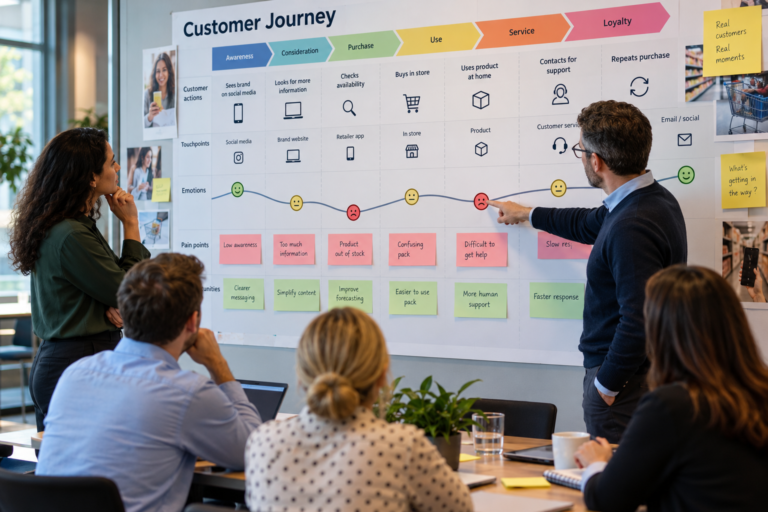

Why CPG leaders need to simplify the business without losing the differences that drive growth.
Executive Summary
Simplification is everywhere in CPG right now, and for good reason. But is consumer behaviour following?
Deloitte’s 2026 Consumer Products Outlook shows that 74% of the 300 senior executives surveyed are simplifying organizational structures. It also notes that 59% are outsourcing core functions or creating centers of excellence. Half expect to rationalise SKUs. Years of adding layers, processes, special cases and reporting requirements have created complexity. This complexity slows them down and consumes resources that could be used more productively.
The difficulty is that consumer behaviour is not becoming simpler at the same time. Choices are spreading across more channels, more need states, and more influences, while growth is increasingly appearing in smaller, harder-to-serve pockets of demand. EY’s 2026 State of Consumer Products research shows retail sales growth for mega brands fell. It declined from 13.1% in 2020–22 to 3.8% in 2023–25, while smaller brands grew just over 8%. McKinsey, meanwhile, describes a purchasing environment where discovery, consideration, and choice are becoming less predictable.
This creates a management problem that is much harder than simply removing complexity. Organizations should separate the complexity they generate from genuine differences across consumers, customers, occasions, and markets. Clear distinctions help target growth opportunities. The first should probably be removed quickly. The second may be precisely where future growth sits.
The question is no longer simply how much complexity a company can eliminate. The question is whether leaders know which complexity consumers miss. It shows what keeps them loyal to the brand.

CPG organisational simplification is overdue in many companies
Anyone who has worked inside a large consumer-goods organisation knows how complexity accumulates. Very little of it starts life as bureaucracy. A market develops its own process because the global one does not quite fit. A new approval is added after a problem, then stays in place long after the original issue disappears. One retailer receives a special pack, and another market adopts a different reporting system. A regional team is created to coordinate local teams while the global team continues to coordinate the region.
Each addition normally has a perfectly respectable history, which is why removing it later becomes difficult. I have worked in organisations where almost everyone privately agreed that parts of a process were unnecessary. Nobody was keen to remove them. Somebody, somewhere, might remember why they had been introduced. Continuing to waste time felt safer. Later, discovering that a seemingly pointless step had once prevented a disaster showed the risk.
So I’m not remotely anti-simplification. Most large companies could remove internal complexity without any customer noticing. And employees would probably thank them for it.
Deloitte’s 2026 research found that 89% of consumer-products executives want to create a culture of greater speed and agility. Sixty-four percent believe AI and automation can trim management layers. They also simplify decision-making when companies face ongoing pressure to raise productivity without sacrificing growth.
The risk appears when simplification becomes synonymous with standardisation.
A simpler process speeds up an organisation. Yet a standard answer can lessen relevance. This occurs when the standard fits the average market, retailer, or consumer. That distinction is easy to miss from the centre of an organisation because the benefits of standardisation appear immediately, while the costs of lost relevance often emerge later and in a different part of the business.
Consumer behaviour is moving in the opposite direction
McKinsey’s State of the Consumer 2026 research, based on 4,863 consumers in Brazil, France, Germany, the UK and the US, describes a path to purchase that is becoming increasingly fragmented. Consumers are discovering and evaluating brands through stores, social media, search, retail platforms and now AI, with younger consumers moving particularly freely between those sources.
Among Gen Z respondents, 23% said they discover new brands through social media, and 34% said social media plays an important role in deciding what to buy. Twenty-eight percent are already using generative AI for shopping. Those figures are interesting, but the broader implication matters more: consumers are becoming harder to compress into one neat funnel or one predictable route to purchase.
The same pattern appears in health and wellness. Consumers are not buying into one broad idea of “healthy” the way companies once defined it. McKinsey’s research identifies very different priorities around sleep, stress, cognitive health, gut health and other specific needs, with considerable variation between the groups driving spending.
From inside the company, these differences can look inconvenient. A global team sees five segments and wonders whether three would be easier to manage. A supply team sees several pack formats and asks whether the portfolio could be reduced. A regional brand team sees markets using slightly different propositions and starts looking for one message that can travel everywhere.
Sometimes that is exactly the right thing to do. Companies should challenge variation rather than preserve it out of habit, because local teams can become just as attached to unnecessary complexity as global teams.
The key is understanding what you’re losing before deciding that less automatically means better.
Some complexity is just waste, but some of it is genuinely where the growth sits
EY’s 2026 State of Consumer Products report makes a distinction that I think deserves far more attention in current transformation programmes. Some complexity adds cost, delay and management effort without creating anything consumers value. Other complexity reflects real differences in consumer behaviour, occasions, channels, or markets and can drive future growth.
EY surveyed more than 850 senior consumer-products executives across 24 markets and concluded that growth is increasingly shifting toward smaller, harder-to-serve demand pools. Its analysis of more than 6,000 brands found that mega-brand retail sales growth slowed sharply between 2020–22 and 2023–25, while smaller brands maintained growth of just over 8%.
I do not read that as evidence that large brands are in trouble simply because they are large. Scale still provides enormous advantages in awareness, distribution, manufacturing, retailer relationships and access to talent.
A more useful interpretation is that scale no longer automatically compensates for weak relevance. A company can be very good at producing, distributing and promoting something consumers care about less than they used to, while a smaller competitor grows by serving a narrower need better.
That is why simplification needs more judgment than most transformation dashboards allow. It is easy to measure the cost of complexity. It is much harder to measure the value hidden inside it.
Portfolio rationalisation is where this becomes very real
Imagine a brand with six pack formats. One represents relatively little volume, costs more to manufacture per unit and complicates planning because its production run is smaller and less regular.
If the company is rationalising its portfolio, the case for removing it looks strong. The numbers may show a cleaner supply chain, fewer materials, lower inventory and better margins.
Then somebody asks who buys it.
Perhaps it is the format older consumers find easiest to lift. It might be the entry price that keeps the brand accessible to lower-income households. It could perform disproportionately well in convenience stores, or play a role in an occasion that remains small today but is growing quickly. One retailer may regard it as important because it attracts a particular shopper.
None of these possibilities automatically means the SKU deserves to survive. Keeping every item because somebody somewhere values it is how companies end up with the complexity they are now trying to remove.
What they do mean is that the business case is incomplete until someone looks at the product’s role beyond its own volume and margin, including whether it serves a distinctive pattern of consumer behaviour the headline numbers hide.
EY makes a similar point in its work on portfolio complexity. Products that look weak in isolation may contribute to basket size, loyalty, or retailer relevance, while apparently healthy products can consume far more operational effort than their financial contribution justifies.
The spreadsheet is not wrong in either case. It is simply answering the question it was designed to answer, and managers need to make sure it is the question that matters.
This is often where experienced mid-level managers know more than the analysis suggests. The Sales Manager remembers why an important retailer fought to retain the format. The local Brand Manager knows which consumers buy it. The Insights Manager knows that a small usage occasion has been growing quietly for several years.
A simplification programme that moves too quickly can remove the complexity before those people have explained the value sitting behind it.
Centralising expertise can create distance as well as scale
The same tension appears when companies reorganise functions rather than products. Deloitte found that 59% of surveyed consumer-products companies are outsourcing core functions or creating centres of excellence, and the logic is obvious. Specialist capability is expensive to replicate in every market, while a strong central team can raise standards, provide better tools and give smaller businesses access to expertise they could never justify alone.
I have worked with excellent global and regional teams throughout my career and have seen exactly what they can add. Good central teams make local managers better by giving them expertise, data, tools and experience they would otherwise struggle to access.
I have also seen what happens when centralisation goes too far.
An Insights centre can become technically excellent while gradually losing contact with the commercial teams making decisions every day. A global innovation process can improve methodological consistency while moving too slowly to respond to a local competitive threat. A regional content operation can create beautiful consistency across markets but flatten some of the cultural differences that make communication work.
The problem is not centralisation itself. It is what happens to proximity, information and decision rights once the work moves.
If local managers still understand consumers, can challenge a global answer when the evidence says otherwise and have enough authority to act when a difference matters, the model can work very well. If every exception requires a long journey back through the organisation, local knowledge gradually becomes less useful because nobody can do much with it.
That is the point at which a centre of excellence risks becoming a centre of control.
Nestlé’s transformation shows how delicate the balance is
Nestlé is currently pursuing a substantial simplification programme, targeting CHF 3 billion in savings by the end of 2027 through structural simplification, standardisation and expanded shared services. At the same time, the company says markets should retain clear accountability for local execution and their operating P&L, with activities moved above market where scale or global coordination creates a genuine advantage.
That balance matters because both sides of the equation are legitimate. Technology, procurement, shared services and specialist capability often benefit enormously from scale. Other decisions depend heavily on local markets, retailers and consumers.
I remember that tension very well from my own Nestlé years. Global capabilities could be extremely powerful when they gave local teams better thinking, tools and expertise. They became far less useful when support quietly turned into prescription, and the market closest to the consumer had to spend more time justifying an exception than responding to what it could already see happening.
For me, the test of a strong central function is therefore not how much control it gains. It is whether local teams become more capable because the centre exists.
Unilever is simplifying while deliberately keeping flexibility
Unilever offers another useful example because parts of its current approach sound contradictory until you look at the logic behind them.
The company is simplifying and focusing the business, while within Beauty & Well-being it has reduced SKUs by more than 30% since early 2024. At the same time, it has created more than ten flexible production lines to support premium products, innovation and channel-specific needs.
That combination is interesting because it shows that simplification does not have to mean reducing every kind of variation.
The business is removing complexity where it appears to consume resources without creating enough value, while preserving flexibility in areas where consumer or channel differences justify it.
That is much more demanding than setting a general target to remove 20% of SKUs or move every market onto the same process. A percentage target is easy to communicate and measure, but someone still has to decide which 20% should disappear.
That is where management judgment returns.
Mid-level managers often become the unofficial system that makes simplification work
Senior leaders usually see the benefits of a simplification programme first. The organisation chart has fewer boxes, costs fall, processes are standardised, and accountability appears clearer.
Mid-level managers tend to discover the exceptions.
The global process works well until an important retailer requires something different. Segmentation is useful until the local market develops a consumer group that doesn’t quite fit. The central research team delivers excellent work but not quickly enough for the decision being made next week. The portfolio is cleaner, although Sales has lost a product that used to open a valuable customer conversation.
Capable managers usually compensate.
They build an unofficial spreadsheet, call someone they know in another market, negotiate an exception or quietly adapt the global material before using it locally. The issue gets solved, and the organisation continues to believe the official model works perfectly well.
Over time, a shadow organisation develops underneath the simplified one. The formal structure looks clean while experienced managers spend more and more time making it work in practice.
I have seen this often enough to become suspicious whenever a transformation programme proudly reports fewer processes while the managers living with the new model tell me privately that their jobs have become harder.
If simplification creates substantial hidden work elsewhere, complexity has not disappeared. It has simply changed address.
The more useful question is “simple for whom?”
This is the question I would introduce into any major simplification discussion.
If a process becomes easier for the company, what changes for the customer or consumer? If the portfolio becomes easier to manufacture, which choices disappear? When expertise moves into a centre, what knowledge becomes further away from day-to-day commercial decisions? If a global standard removes local discretion, where might that discretion still create value?
These questions should not become an excuse for defending every local exception. I have heard “our market is different” far too many times to believe every variation deserves protection.
Customer centricity needs evidence, not sentiment.
The company should be able to explain what value a piece of complexity creates, for whom it creates it and whether the same value could be delivered more simply.
That is a much more useful conversation than arguing about simplification in principle.
QC2™ helps managers see what the company might be removing
This is where QC2™ becomes particularly relevant because simplification rarely touches only one part of the business.
The company has an objective, perhaps lower cost, faster decisions or easier execution. That objective should be clear enough that people can judge later whether the change actually delivered it.
Customer and consumer understanding provides another perspective. Which differences in consumer behaviour genuinely influence choice, usage, value or loyalty, and which ones exist because the organisation has grown accustomed to doing things a certain way?
The brand brings a further question. A brand that wins through personalisation, specialist expertise, local relevance or broad choice needs to examine simplification differently from one built around simple, consistent value.
Processes then need the same scrutiny. Some genuinely protect quality, customer value or regulatory requirements, while others have survived because nobody has asked why they are still there.
Looking across all four keeps simplification from becoming an internal cost exercise.
It also gives mid-level managers a much stronger way to challenge decisions. Saying “this will not work in my market” is rarely persuasive enough on its own. Explaining which consumer need, brand promise, retailer relationship or process outcome is likely to be affected makes the discussion far more commercial.
Simplification should create more room for consumer understanding, not less
EY’s figures help explain why this matters now. Between 2020–22 and 2023–25, the mega brands in its analysis lost 1.2 percentage points of market share while smaller brands gained 1.9 points.
Large CPG companies still have advantages smaller competitors would love to own, including scale, distribution, retailer relationships, technical capability and brands with decades of accumulated trust.
Simplification should make those strengths easier to use. It should remove work customers never valued, reduce delays that serve no purpose and give managers more time to understand what is changing outside the organisation.
If the result is a company that is cheaper and neater internally but slower to recognise changes in consumer behaviour, less able to respond to local differences or increasingly distant from consumers, the savings may prove expensive.
The aim should therefore be a simpler company, but not a simpler view of the market.
Want to know what to simplify without losing what creates value?
The Business Accelerator™ is designed for managers who need to make exactly these kinds of decisions, not just discuss customer centricity in theory.
Over ten hours of practical video learning, business examples, quizzes, and downloadable workbooks, the programme shows you how to examine company priorities, customers, brands, and processes through QC2™ (Quantum Customer Centricity) and identify where customer-centric growth is being strengthened or lost.
It’s fully online and self-paced, so managers can apply the thinking directly to decisions they are dealing with now. And since last month, the complete programme is now available in both English and French.
During November, the QC2™ Business Accelerator course is available for only CHF 1,999. (That’s more than a third off the 2027 price!)
If your organisation is simplifying, centralising, restructuring, or rationalising, this may be a good time to check whether you are removing complexity that costs you or complexity your customers still value.
Explore the Business Accelerator™ Course