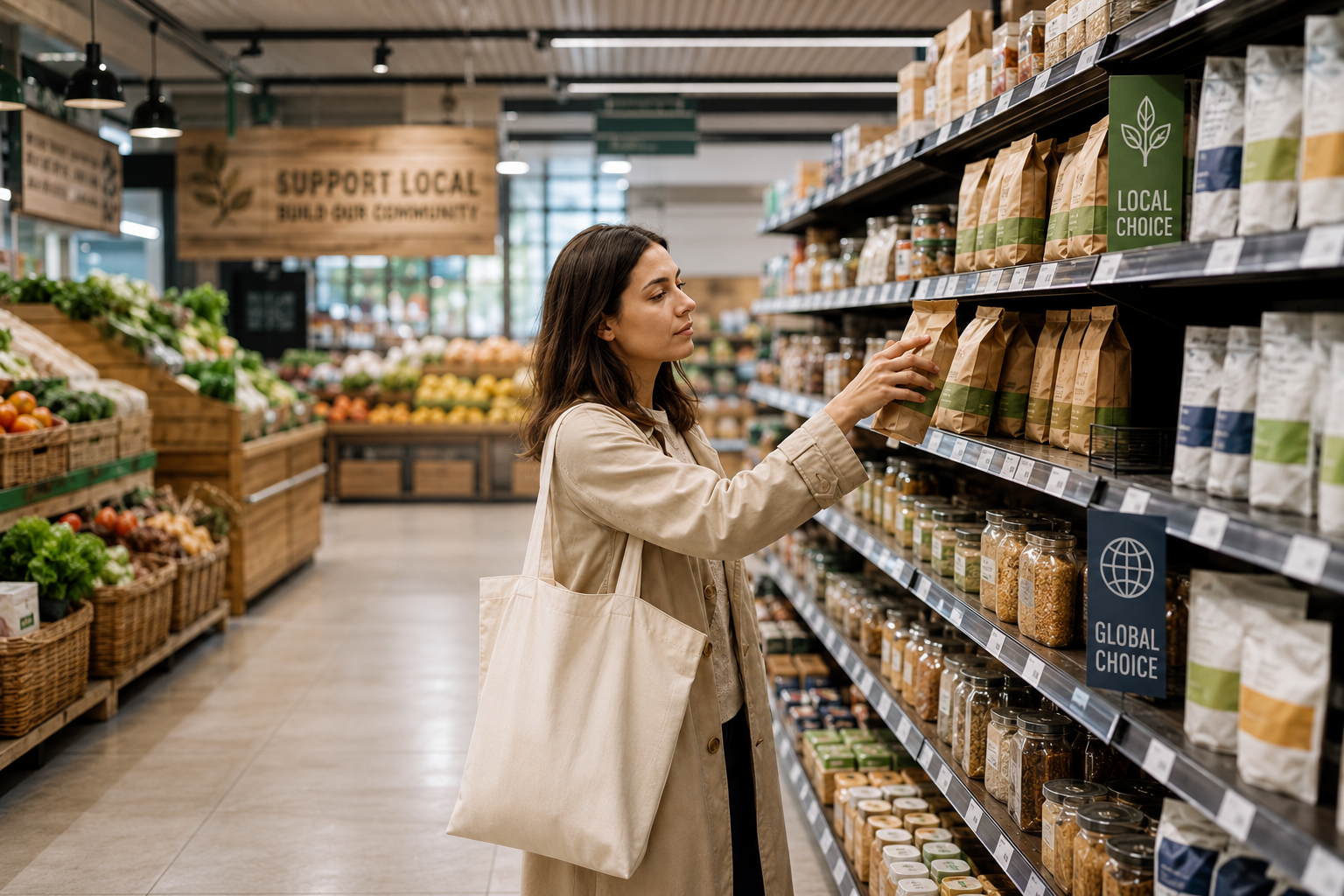
Remember the Buy Local Trend? It’s back! Supply chain shocks amplify it, and global brands must earn local trust again.
Executive summary
Consumers prefer local when uncertainty rises, because familiar choices feel safer and more accountable. Reuters analysis published May 18, 2026 estimates the current U.S.-Israeli war with Iran has already cost global companies at least $25 billion, with disruption linked to trade routes, energy prices, and input costs.
A second-order effect shows up quietly, then suddenly. Consumers tighten their trust circle and lean toward what feels closer, more accountable, and less risky.
Edelman’s 2026 Trust Barometer frames this as a “trust amid insularity” dynamic, and one of its top findings is striking: 34% of the general population would accept higher prices and fewer choices to limit foreign companies operating in their country.
That mindset shift has consequences for global brands. McKinsey’s State of the Consumer report notes that 42% of European survey respondents said they had a worse or somewhat worse perception of American brands in May 2025 compared with the beginning of the year. The specific example is American brands, but the mechanism is broader: country cues can quickly leak into brand sentiment.
This post explains why the country of origin effect and buy local trend strengthen after shocks, what it means for global brand trust in the US, UK, and beyond, and what mid-level CPG managers can do now to keep momentum without pretending their brand is something it isn’t.
Prefer to Listen:
Supply chain shocks: why boardrooms fear knock-on effects
Reuters describes the Iran conflict’s corporate cost as more than a headline, highlighting disruptions tied to shipping routes, oil prices, petrochemicals and other inputs, with at least $25 billion in impact across companies so far.
That is the measurable side. The lived side inside CPG is the chain reaction that follows. Cost pressure triggers pricing discussions. Pricing discussions trigger retailer conversations. Retailer conversations trigger promotion debates and supply prioritisation. Those debates often slow decisions because nobody wants to be the person who “overreacted” and got it wrong.
Shoppers do not see those internal negotiations. They experience the output as shelf gaps, substitutions, smaller packs, inconsistent availability, and price movement. That experience changes what “trust” feels like in the aisle. Trust becomes less about brand love and more about confidence that you will get what you expect.
A practical question belongs early in every category meeting during volatility: what does “safe” mean to the shopper right now. Plenty of teams assume “safe” means cheaper. Many shoppers interpret “safe” as predictable, familiar, and unlikely to disappoint. That difference is where margin and loyalty quietly move.
CPG resilience becomes commercially meaningful when consumers can feel it as stability, not just read it in a corporate report.
Consumers prefer local when risk rises
YouGov’s cross-market polling from 2023 found that consumers vary by country, yet the preference for domestic purchase shows up strongly in several markets, with 54% in Great Britain saying they’re more likely to buy from a British company.
That is not a perfect “global number,” and it’s useful precisely because it shows nuance. The UK is often less protectionist than people expect, yet even there a majority still leans domestic. Consumer localism is not a uniform ideology. It’s a response to perceived risk, identity, and accountability.
McKinsey adds another layer that matters for your audience. Their April–May 2025 survey across the US, UK, Germany and China asked why consumers prefer domestic brands. McKinsey reports 36% say they want to support domestic businesses and 20% say local brands better fit their needs. Only 13% say domestic brands are more affordable. That’s a big clue. Local preference is often about fit and familiarity, not price.
Edelman’s 2026 Trust Barometer supports the broader “trust circle narrows” narrative, describing insularity as a defining feature of current trust dynamics.
That is the data. The real-world behaviour looks like this: shoppers simplify. They avoid regret. They choose what feels dependable. “Local” becomes a shortcut for that dependability, even when the local product is not objectively more reliable.
A useful decision question for brand teams: which parts of our proposition rely on being “global,” and which parts must feel “close” and culturally fluent to be trusted. Global brand trust now depends on answering the second part clearly.
Country of origin effect: why sentiment shifts faster than product reality
McKinsey’s State of the Consumer report says 42% of European respondents had a worse or somewhat worse perception of American brands in May 2025 than at the beginning of the year.
This is the country of origin effect in motion. Consumers are not sitting down to do a rational assessment of brand ownership or manufacturing location. They are absorbing cues from headlines, social media, public conversations, and then those cues leak into preference, willingness to pay, and switching behaviour.
The uncomfortable part for global companies is that the product does not need to change for perception to shift. Sentiment can drift even when quality is stable. When sentiment drifts, retailers become more receptive to local challengers and private brands, and consumers become more price-sensitive toward the brands they feel less emotionally connected to.
A practical question that helps mid-level managers spot this early: what would a consumer assume about us if they only saw our brand name and origin cues, with no other context. That question sounds simple, but it forces you to look at your packaging cues, retailer content, and brand story through a lens that is suddenly more active.
The most useful comment here is not “country of origin effect is bad.” The useful comment is that it is often invisible until it shows up in share and margin, so it needs to be managed like any other commercial risk.
Why global brand trust is slipping
Edelman’s Top 10 findings include that 34% of the general population would accept higher prices and fewer choices to limit foreign companies operating in their country.
That is a remarkable willingness to trade convenience for perceived control, and it tells you why global brand trust can soften after shocks. People under pressure look for control. Local brands and domestic companies can feel like control, even when the supply chain is still global behind the scenes.
YouGov’s UK findings show that “domestic leaning” exists even in a market that isn’t the most protectionist among those surveyed.
McKinsey’s “why local” data shows local preference is often about supporting domestic businesses and local fit, not price.
These signals explain the boardroom worry: global brand trust is no longer a default advantage. It must be earned locally.
The trap global brands fall into is reacting by defending “global” harder. Heritage, reach, scale, big global campaigns. Consumers under stress are not asking for global reach. They are asking for reassurance that the brand understands their local reality, will be available, and will not surprise them.
A question that changes the brief: what do we do for people here, this month, that a local challenger cannot do. Answers that work are concrete. Consistency. Transparency. Availability. Clear benefits. Fewer surprises. Better service recovery.
Global trust recovers when global scale is translated into local benefit.
Buy local trend does not mean “local only”
McKinsey’s research shows only 13% cited affordability as the reason domestic brands are preferred, while 36% cited support for domestic business and 20% cited better fit.
That nuance matters. The buy local trend is not always a rejection of multinationals. It’s a demand for fit, accountability, and confidence. Global brands can still win, but they must do the work of local fluency.
Local fluency means the brand speaks like it understands the local moment. It knows local usage occasions. It reflects local values without preaching. It avoids tone-deaf global messaging when people are tense. It uses local proof points and local partnerships to feel accountable.
This is where consumer localism is often misunderstood. It’s not just “where it’s made.” It’s “does this brand feel like it belongs in my life, in my place, right now.”
A useful question for teams: what is the local job-to-be-done that we solve better than anyone else. That helps you write a local story without needing to change the core product.
CPG resilience is now a consumer-facing advantage
Reuters describes companies raising prices, cutting production, and adapting operations during the current conflict due to energy, logistics, and supply impacts.
Consumers experience those adaptations as instability. Instability raises perceived risk. Raised risk strengthens consumer localism because familiar feels safer.
That is why CPG resilience must become visible. Reliability becomes a brand feature during shocks. Reliability means the trust-anchor SKUs are available. It means the product experience stays consistent. It means pack changes are explained clearly. It means customer support solves problems rather than looping consumers in bureaucracy.
Edelman’s finding that a third of the population would accept fewer choices and higher prices to limit foreign companies shows how strongly some consumers value control and certainty.
A question that keeps this practical: what one change would reduce perceived risk for a cautious shopper this week. Many teams answer with “a discount.” Plenty of shoppers answer with “certainty.” That gap is where repeat purchase is won or lost.
What mid-level managers can do now
McKinsey’s cross-market data suggests local preference is driven more by support and fit than by price.
That’s helpful because it points to actions beyond discounting. Mid-level managers can create momentum quickly by focusing on three areas that reduce perceived risk and increase local accountability.
Reliability moments come first. Identify the handful of products, formats, and claims that anchor trust in your category. Protect those. A brand that keeps its trust anchors stable protects global brand trust more effectively than a brand that tries to protect everything equally.
Local proof comes next. Consumer localism rises when people want reassurance close to home. Local proof can be retailer partnerships, community cues, local usage occasions, locally relevant service recovery, and locally sourced messages that are factual rather than sentimental. This is not about pretending the brand is local. It’s about proving the brand is accountable locally.
Choice simplification comes third. Volatility increases cognitive load. Shoppers avoid complexity. Local challengers often win because they make decisions easier. Range simplification, clearer pack hierarchy, and fewer confusing variants can lift conversion without price cuts.
A question to keep it grounded: what one change would make a cautious shopper feel confident choosing us at full price this week. That question produces better action than another abstract debate about localisation strategy.
A QC2™ and CATSIGHT™ path when organisations get stuck
Shocks often trigger internal conflict. Sales wants immediate retailer moves. Finance wants protection. Brand wants meaning. Operations wants feasibility. Work stalls when everyone argues from a different frame.
QC2™ can be used quietly to pinpoint where the real constraint sits, whether it’s company decision rights, consumer reality, brand role clarity, or process friction.
CATSIGHT™ then keeps the work human by translating business objectives into the attitude and behaviour change that must happen locally, then into action that reduces perceived risk.
Both tools work best as accelerators after the practical moves above are chosen. The reader’s dilemma stays central. The frameworks offer a cleaner path out of circular debate.
In Conclusion
Geopolitical disruption is already imposing real costs on companies. Reuters estimates at least $25 billion in corporate impact tied to the current conflict.
Consumer response often takes the form of tightening trust circles and leaning local. Edelman’s 2026 Trust Barometer finding that 34% would accept fewer choices and higher prices to limit foreign companies shows how strong that instinct can be.
Country cues can quickly influence sentiment, with McKinsey reporting 42% of European respondents having a worse or somewhat worse perception of American brands in May 2025 than earlier that year.
Global brands can still win, but the free pass has disappeared. Global brand trust now needs local proof, local fluency, and visible reliability. CPG resilience becomes a competitive edge when consumers feel uncertain, because stability and transparency reduce perceived risk.
If the buy local trend and country of origin effect are starting to show up in your category, C3Centricity can help you respond without panic and without generic “localisation theatre.”
Start with a short diagnostic to pinpoint where trust is slipping, whether it’s consumer reassurance, brand clarity, retailer execution, or internal process friction. Use the C3Centricity Contact page to request a short Business Makeover Session, and we’ll suggest the most useful starting point for your business.